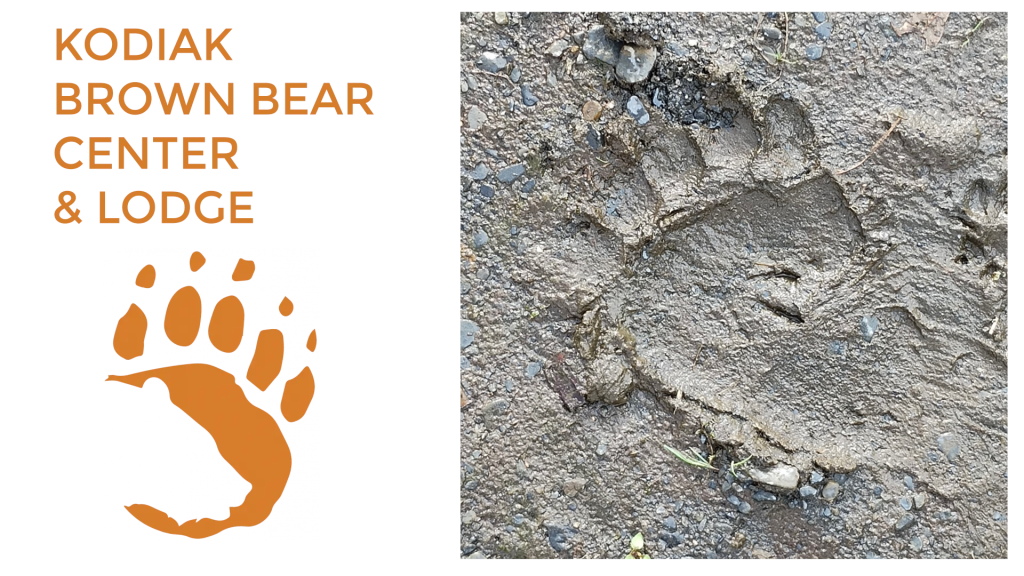
A bear paw print is on our logo, and there is a reason for that beyond decoration. On Kodiak you often meet the bear before you meet the bear — a print in the wet sand at the edge of a salmon stream, big enough that your own boot fits comfortably inside it.
Read that print properly and it tells you the species, roughly the size of the animal, which direction it was heading and how long ago. It is the oldest skill in bear country and still the most useful.
Here is what a bear’s paw is actually made of, how the sizes compare across species, and the single test that separates a brown bear track from a black bear’s.
What a bear paw is made of and how does it walk
Bears walk the way we do. They are plantigrade — the whole sole makes contact with the ground, heel included. That is unusual among large carnivores. A wolf or a big cat walks on its toes, which is why their tracks are compact ovals and a bear’s hind print looks unsettlingly like a broad, clawed human footprint.
Every bear, in every species, has five toes on every foot. If you count four, you are looking at a canine or a cat.
The print itself is made up of a few distinct parts:
- Toe pads — five, arranged in an arc across the front of the track. The innermost toe is the smallest, which is the opposite of a human foot and a genuinely useful thing to remember when you are working out which direction a bear was walking.
- The main pad — the broad, roughly kidney-shaped cushion behind the toes. On a front foot this is wide and blocky. Trackers measure its width, because it scales reliably with the size of the animal.
- The heel pad — on the hind foot only, a separate lobe behind the main pad. It is what makes a bear’s hind track so long and so human-looking.
- Claws — one per toe, and here is the key point: a bear’s claws do not retract. Unlike a cat, a bear cannot sheathe them. They are permanently out, permanently in contact with the ground, and so they register in the track whenever the ground is soft enough to take the impression.
Bear paw and track sizes compared
The front and hind feet are different shapes, not just different sizes. The front track is wide and squat; the hind is long and narrow. People measuring a track for the first time often compare a front print to someone else’s hind print and conclude they have found a monster.
Polar bears break the pattern. Their paws can be around 12 inches across — roughly a dinner plate — which is enormous even relative to their body size. That is not about power. It is a snowshoe. Spreading 1,000 pounds across that much surface area is what lets a polar bear cross sea ice too thin to hold it otherwise.
Kodiak bears sit at the very top of the range. A large male can stand over ten feet tall on his hind legs and weigh up to 1,500 pounds, and the tracks scale accordingly.

The one-line test: brown bear or black bear?
This is the field skill worth actually learning, and it comes straight from the National Park Service. It works on a front track.
Lay a straight edge along the base of the big toe — the largest toe, on the outside of the track — and run it across the top of the main pad.
On a brown or grizzly bear track, that line passes through or below the bottom half of the smallest toe. The toes sit close together in a fairly straight row.
On a black bear track, the line passes through the top half of the smallest toe. The toes are more separated and more strongly arced.
It sounds fussy written down. In front of a real track it takes about four seconds, and it is far more reliable than guessing from size — a large black bear and a young brown bear overlap considerably, and colour tells you nothing at all.
The second tell is the claws. Brown bear claws run 2 to 4 inches and are only slightly curved, so they print as distinct marks set well forward of the toe pads. Black bear claws are under 2 inches and sharply hooked, so they often leave nothing at all, or a small nick tight against the toe.
Why the claws differ: digging versus climbing
The claw difference is not arbitrary. It is two completely different jobs.
A brown bear’s front claws are excavation tools. Long, relatively straight and blunt, they are built for turning over ground — digging roots and bulbs, tearing apart rotten wood, and on Kodiak, working the sedge flats in spring. The same anatomy that makes a brown bear an efficient digger makes it a poor climber; the claws simply will not hook.
A black bear’s claws are the reverse. Short, sharply curved and needle-tipped, they are climbing gear. A black bear cub can be up a tree in seconds. This is the origin of the old and only partly reliable advice about which bear will follow you up a tree.
That difference also drives the shoulder hump you see on a brown bear. It is not fat — it is the muscle mass powering those digging forelimbs, and it stays there year-round.

Content Author & Alaska Photographer
I lead photography workshops at the Kodiak Brown Bear Center and create engaging, high-quality content for blogs and websites across Alaska and beyond. My deep passion for wildlife—especially Kodiak bears—continually inspires my work and fuels my storytelling.
Sources
- National Park Service — Bear Identification: https://www.nps.gov/articles/bear-identification.htm
- Alaska Department of Fish and Game — Kodiak Brown Bear Fact Sheet: https://www.adfg.alaska.gov/index.cfm?adfg=brownbear.trivia
- Polar Bears International — Adaptations and Characteristics: https://polarbearsinternational.org/polar-bears/polar-bear-facts/adaptations-characteristics/
- WWF Canada — Paws and Claws: Polar Bear Foundations: https://wwf.ca/stories/paws-claws-polar-bear-foundations/
- North American Bear Center — Polar Bear Facts: https://bear.org/bear-facts/polar-bear-facts/