Bear In the water fishing

Why Kodiak Brown Bear Center is Your Wildest Dream Destination

A Kodiak brown bear stands in a river with green grass and trees in the background. On the left, orange text reads Kodiak Brown Bear Center Lodge above a stylized bear paw print.

Ever dreamed of getting up close and personal with a Kodiak brown bear? Not, like, too personal (they’re wild, after all!), but close enough to witness their incredible power and grace in their natural habitat? Then pack your bags, adventurer, because the Kodiak Brown Bear Center (KBBC) is calling your name!

Forget crowded boardwalks and distant binoculars. The KBBC offers an unparalleled, intimate bear viewing experience that’s more “National Geographic documentary” and less “theme park queue.”

Tucked away in the heart of the Kodiak National Wildlife Refuge, this isn’t just a lodge; it’s a gateway to a truly wild Alaska.

Getting Here is Half the Fun

First off, let’s talk about the journey. Getting to the KBBC is an adventure in itself! Imagine soaring over breathtaking mountains and glistening fjords in a floatplane – a truly Alaskan welcome.

Keep your eyes peeled, because the journey often offers sneak peeks of whales, eagles, and even mountain goats. Talk about setting the mood!

Once you land on the lake, you’re not just a tourist, you’re a guest of the Alutiiq people, who have lived on Kodiak Island for millennia.

This rich cultural connection adds an incredible layer to your experience, allowing you to learn about the land and its history from those who know it best.

Float Plane Ready To Goto KBBC

Let's Get Outside

Now, for the main event: the bears!

The Karluk watershed, where the KBBC is located, boasts one of the highest concentrations of Kodiak brown bears in the world. And here’s the magic: the KBBC prides itself on small groups and exclusive access to over 112,000 acres of prime bear habitat. This means no jostling for a view, just incredible opportunities to watch these awe-inspiring creatures in their element.

Picture this: you’re with an expert guide, watching bears skillfully snatching salmon from rushing rivers, playfully interacting by the lake, or perhaps even using ancient stone fish traps built by the Alutiiq people centuries ago.

Whether from strategically located viewing areas on land or from their comfortable catamaran, every perspective offers a unique glimpse into the daily lives of these magnificent animals.

Two people wearing colorful jackets and hats hold cameras with large telephoto lenses, aiming them forward while standing in a lush, green outdoor setting. Taken by Dan M Lee
Dan M Lee
A brown bear and its cub stand at the edge of a river, bending down to drink water, surrounded by green grass and plants. Taken by Dan M Lee
Dan M Lee
Bear In the water fishing
Dan M Lee

Explore Our Facilities

Beyond the bears, the KBBC offers cozy, private cabins with stunning views of Karluk Lake, delicious, locally sourced meals, and even a traditional Alutiiq “banya” (steam bath) for a truly unique relaxation experience.

So, if you’re ready to trade the everyday for an extraordinary encounter with some of the world’s largest land predators (plus a few surprise visitors to our site), all while enjoying comfortable accommodations and genuine Alaskan hospitality, the Kodiak Brown Bear Center is an absolute must.

Get ready for a bear-y good time!

Fox Asleep At KBBC Campus
Dan M Lee
bear viewing and fly fishing in Alaska

Ready for an adventure?

Camp Island Alaska

Camp Island, Karluk Lake: A Journey Through Kodiak’s Past

Black and white photo of a smiling young woman wearing traditional attire and headband with beads. On the left, text reads, Kodiak Brown Bear Center Lodge next to an orange bear paw print graphic.

Kodiak Island, Alaska’s “Emerald Isle,” is a land of rugged beauty and deep history. Within this expansive archipelago lies Camp Island, a distinct island in the middle of Karluk Lake on Kodiak’s southwest side.

This specific island, not other general “camps” on Kodiak, holds a unique historical narrative, from ancient indigenous life to modern conservation efforts.

A Place of Ancient Roots: Alutiiq Heritage on Karluk Lake

The Karluk Lake region, including Camp Island, has been continuously inhabited by the Alutiiq (Sugpiaq) people for over 6,000 to 7,500 years, making it a highly productive salmon system.

Hundreds of ancestral sites, over 46 in the Karluk area, are considered an “Alutiiq library” of their past. Early nomadic life evolved into sod dwellings, with a few large and small multi-room structures.

Archaeological finds include substantial salmon processing settlements from 300 years ago and 3,000-year-old sod homes.

The Alutiiq’s traditional knowledge and ancient stone fish weirs demonstrate their enduring connection to Karluk Lake, embodying the philosophy, “This is the land that we belong to, not the land that belongs to us“.

Aerial view of a lush green landscape with Katmai Lake and nearby Surprise Lake, surrounded by mountains. A map pin marks a location on Katmai Lake; Kodiak Island Wildlife Refuge is labeled in the distance.

Camp Island & Karluk Lake: A Historical Snapshot

Year/Period

Event/Significance

7,500+ Yrs 

Alutiiq/Sugpiaq habitation of Karluk Lake area begins; nomadic tent living, early camps  

~4,000 Yrs

Focus on fishing intensifies, development of nets, larger settlements  

~800 Yrs

Population peak, large multi-room sod houses (ciqlluat), intensified salmon fishing  

1786

Russians establish trading post/salmon saltery at Karluk  

1882

First salmon cannery on Kodiak Island built at Karluk Spit  

1889

Biologists begin using Camp Island as a base camp for fisheries studies  

1927

U.S. Bureau of Fisheries (USBF) builds first cabin on Camp Island  

1930s

Karluk canneries close due to overfishing  

1941

Kodiak National Wildlife Refuge established, encompassing Karluk Lake  

Present Day

Camp Island hosts Kodiak Brown Bear Center & Lodge, owned by Alutiiq people, focusing on conservation and bear viewing  

Kodiak brown bears in the wild at kodiak brown bear center

A Place of Ancient Roots: Alutiiq Heritage on Karluk Lake

The name “Camp Island” (also “Thumb Island”) originated from its use as a scientific base.

From 1889, biologists like William Morton and Allan DeLacy used this central Karluk Lake island for fisheries studies, valuing its location and protection from bears. The U.S. Bureau of Fisheries built the first cabin in 1927, supporting researchers who collected diverse biological specimens through the 1950s.

This established Camp Island as a key site for understanding Karluk Lake’s globally renowned sockeye salmon runs, marking a shift towards scientific resource management.

A Modern Sanctuary: The Kodiak Brown Bear Center

Today, Camp Island is home to the Kodiak Brown Bear Center & Lodge (KBBC), owned by Koniag, the Alaska Native Regional Corporation representing the Alutiiq people. This ownership reflects the Alutiiq value of Nunapet (“ties to our homeland“) and their deep connection to the land.

The KBBC offers world-class bear viewing, fishing, and hiking within the Kodiak National Wildlife Refuge, which has one of the highest concentrations of Kodiak brown bears globally.

The center emphasizes minimal impact through small groups and sustainable power (wind, solar), aligning with the refuge’s 1941 mission to protect bears and their habitat. 

Beyond the Island: Karluk Lake's Broader Historical Tapestry

Camp Island’s history is part of Karluk Lake’s broader narrative.

Russian hunters established a trading post at Karluk in 1786. Post-1867, commercial salmon canning boomed, with Karluk hosting Kodiak’s first cannery in 1882, though overfishing led to closures by the late 1930s. Kodiak Island also served as Russian America’s first capital (1792-1804) and faced natural disasters like the 1912 Novarupta eruption and the 1964 earthquake.

Importantly, while Kodiak Island was a strategic WWII military site, records show no specific military presence on “Camp Island” in Karluk Lake itself.

Camp Island's Enduring Legacy

Camp Island, in Karluk Lake, Kodiak, embodies a remarkable journey.

From millennia as an Alutiiq resource hub, sustained by salmon, it transitioned into a vital scientific base. Today, under Alutiiq ownership at the Kodiak Brown Bear Center, it’s a conservation-focused sanctuary for bear viewing and sustainable tourism.

This trajectory highlights the enduring connection between people, place, and the Alaskan wilderness.

bear viewing and fly fishing in Alaska

Ready for an adventure?

Sow Female Bear With Young

How to Tell the Difference Between Male and Female Kodiak Brown Bears

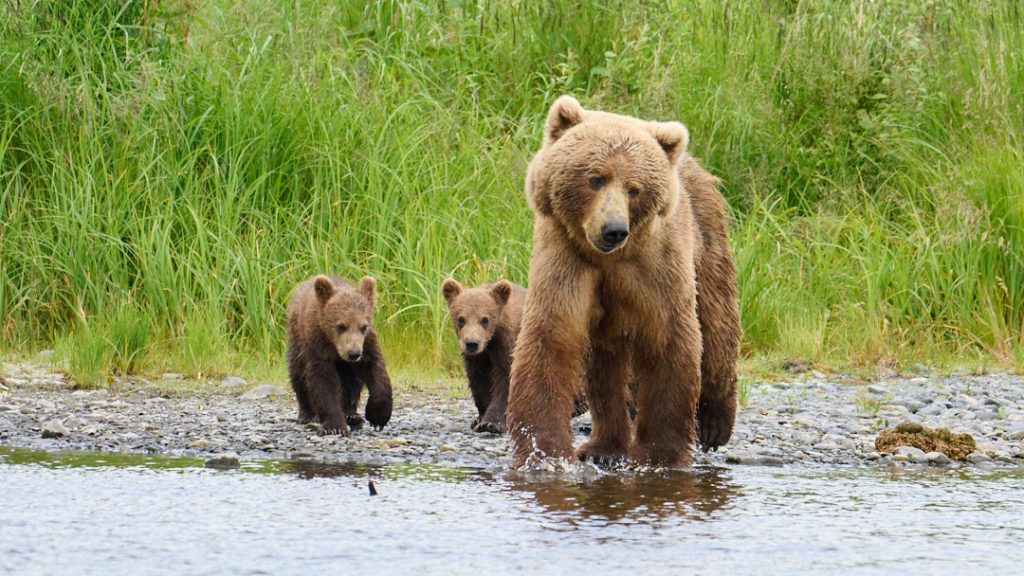
A Kodiak brown bear with two cubs walks along a riverbank with green grass behind them. On the left, orange text reads Kodiak Brown Bear Center Lodge above a bear paw print.

Kodiak brown bears are massive, powerful, and—at first glance—can look quite similar regardless of gender. But with a bit of observation and the right knowledge, you can learn to distinguish a boar (male) from a sow (female) in the wild.

This skill can add depth to your bear watching experiences and help you understand more about their behaviors, especially if you’re lucky enough to view them in the wilds of Kodiak Island, Alaska.

Size and Build: Bigger Isn't Always Better… Unless You're a Boar

The most obvious difference is size. Adult male Kodiak bears are typically much larger than females. Boars can weigh over 1,200 pounds, with some tipping the scales at 1,500 pounds or more. They tend to have a heavier, bulkier build with broader heads, thicker necks, and heavily muscled shoulders.

Females, in contrast, are more streamlined and less blocky in appearance. They generally max out around 600 to 800 pounds, though large sows can appear closer in size to younger or leaner males, especially during the summer before the fall fattening season.

Boar male Kodiak Brown Bear
Dan M Lee

Head Shape and Facial Features

Boars tend to have a wider, more square-shaped head and thicker, shorter necks. Their faces often appear flatter and more robust, particularly around the snout and jaw.

Sows have narrower, more tapered heads with longer-looking snouts and slightly more delicate facial features. If you get a good profile view, look for a smoother, more sloped forehead in females.

Reproductive Clues

The presence of cubs is the clearest giveaway that you’re looking at a sow.

Females typically give birth in the den during winter and raise cubs for 2 to 3 years, meaning there’s a good chance of seeing young bears with their mother in spring and summer.

Boars, on the other hand, never take part in raising offspring. In fact, adult males can be dangerous to cubs, as they sometimes kill them to bring the mother back into estrus.

Behavior: Solitude vs. Family Life

Male Kodiak bears are usually solitary, especially outside of mating season. They may be seen walking alone, often covering long distances and keeping a noticeable distance from other bears unless they’re competing or mating.

Females, especially those with cubs, are far more likely to be seen in small groups.

A sow with cubs will stay close to them, guiding them across rivers or helping them fish. She’s also highly alert to other bears, particularly males, which may pose a threat to her young.

If you see a bear acting extremely cautious or defensive—frequently looking over her shoulder or bluff-charging others—it’s likely a mother protecting her cubs.

Sow Female Bear With Young
Dan M Lee

Urination and Genital Markers (Advanced Observation)

This is for the seasoned observer with binoculars or a telephoto lens: you can sometimes identify gender based on how a bear urinates.

Females tend to urinate directly below or behind them, while males will urinate forward and downward, with more visible genitalia if seen from the right angle.

This method isn’t always practical—or polite—but for scientific observation or photography, it can be one more clue.

Recognizing the differences between male and female Kodiak brown bears helps deepen your appreciation for their behaviors and survival strategies.

Whether it’s a lone boar lumbering across a river or a protective sow fishing with her cubs, each encounter offers a window into the incredible lives of these apex predators.

Just remember—whether you’re observing males (Boars) or females (Sows), always do so from a safe distance, with respect for the bear’s space and natural behavior. After all, you’re a guest in their world.

bear viewing and fly fishing in Alaska

Ready for an adventure?

Close-up of delicate purple wildflowers in a sunlit field, with bright sunlight creating a warm, soft glow and blurred background of green grass and distant hills. Taken by Dan M Lee

The Wild Flora and Fauna of Kodiak Island

Kodiak Brown Bear Center Lodge logo with a bear paw print on the left, and a sunlit field of wildflowers in soft focus on the right.

The Wild Flora and Fauna of Kodiak Island: Nature Untamed

Kodiak Island, often called Alaska’s Emerald Isle, is not only home to the legendary Kodiak brown bear but also to a lush and vibrant tapestry of plant and animal life.

Its remote location, rugged terrain, and unique climate—mild by Alaskan standards—combine to create a rich and diverse ecosystem that bursts with color and life from the forest floor to the mountaintops.

Flora: From Coastal Meadows to Alpine Blooms

Kodiak’s plant life thrives in the summer months, with long daylight hours and abundant rainfall helping to transform the landscape into a sea of green, gold, and violet. Coastal meadows and hillsides are dotted with wildflowers like:

  • Fireweed – A tall, magenta flower that blooms after disturbances like wildfires, often carpeting open spaces and road edges by late summer.

  • Lupine – These purple-blue spikes brighten up the island’s meadows, particularly in early summer.

  • Arctic daisies, shooting stars, and monkshood – Smaller, delicate blooms that thrive in alpine areas, often blooming near streams or rocky outcroppings.

  • Crowberries and blueberries – Low-growing shrubs that produce edible berries, vital not just to bears but to foxes, birds, and even humans.

Thick stands of Sitka spruce, alders, and willows dominate the island’s forests, providing shelter and food for countless animals. Lush mosses and ferns blanket the forest floor, soaking up the constant moisture that gives the island its rich, emerald appearance.

Close-up of delicate purple wildflowers in a sunlit field, with bright sunlight creating a warm, soft glow and blurred background of green grass and distant hills. Taken by Dan M Lee
Dan M Lee

Fauna: Wild, Winged, and Wonderful

Kodiak’s animal life is just as diverse and captivating. Of course, the Kodiak brown bear is the undisputed star—these massive, intelligent omnivores are found throughout the island. But look a little closer and you’ll find a whole cast of characters in the wild.

Birds are everywhere. The island lies along a major migratory route, making it a hotspot for birdwatching. You’ll see:

  • Bald eagles, nesting high in the spruce trees or swooping down to catch salmon from rivers.


  • Puffins, murres, and cormorants nesting along the rocky coastlines and offshore cliffs.


  • Sandhill cranes, ravens, and countless species of waterfowl, especially around the island’s wetlands and lakes.


On land, red foxes roam the fields and beaches, sometimes bold and curious, other times shy and swift. The island’s Sitka black-tailed deer, introduced in the early 20th century, are now widespread and often seen grazing in open meadows or wandering into town. River otters, weasels, and the occasional beaver can be spotted near streams and lakes.

Offshore, the waters surrounding Kodiak are equally alive. Sea otters, harbor seals, and Steller sea lions haul out on rocky beaches or float in the kelp beds. In summer, gray whales, humpbacks, and orcas patrol the coastlines, offering unforgettable glimpses of marine majesty.

A bald eagle with a white head and yellow beak perches on a tree branch, surrounded by green leaves and branches. The eagle appears to be looking down, partially obscured by the foliage. Taken by Dan M Lee
Dan M Lee

A Living Island

What makes Kodiak Island so remarkable is how its flora and fauna intertwine—the wildflowers feed the insects, which feed the birds, which become prey or companions in a much larger ecological story. The bears depend on berries and salmon, just as the foxes do on leftovers and scavenged carcasses. It’s a closed loop, rich with life and ruled by the seasons.

Whether you’re walking through a wildflower-draped meadow or watching a bald eagle launch from a spruce tree, Kodiak offers a front-row seat to one of the most intact and vibrant ecosystems in North America.

bear viewing and fly fishing in Alaska

Ready for an adventure?

Secret Life of bears a yearly cycle

A Year in the Life of a Kodiak Brown Bear

A brown bear stands in shallow water with mountains and a bird in the background. To the left, orange text reads Kodiak Brown Bear Center Lodge above an orange bear paw print.

A Year in the Life of a Kodiak Brown Bear

The Kodiak brown bear, one of the largest land carnivores on Earth, leads a life shaped by the extreme rhythms of Alaska’s seasons. Found only in the Kodiak Archipelago, these bears have adapted to a yearly cycle that revolves around survival, reproduction, and preparing for the long Alaskan winter.


Spring: The Wake-Up Call

After spending up to six months hibernating in dens tucked into the island’s mountains or thick brush, Kodiak bears emerge groggy but hungry in late April or early May. Males are the first to rise, followed by females without cubs, and then females with new offspring—who remain tucked away a little longer for safety.

Food is scarce at first. The bears scour riverbanks and beaches, feeding on early greens like cow parsnip and sedge, or scavenging on winter-killed animals. This lean period doesn’t last long, though—once the salmon start returning, everything changes.

A large brown bear sits on grass surrounded by greenery, with two bear cubs close by—one sitting alert and the other lying down, partially hidden. Taken by Dan M Lee
Dan M Lee

Summer: The Feast Begins

By June, the island is alive with food. Salmon runs bring an ocean’s worth of protein and fat to the streams, and bears gather in droves to catch fish. At places like Karluk Lake and Frazer River, you’ll see bears fishing shoulder to shoulder—well, as close as their solitary natures allow. It’s a feast that sets the tone for the rest of the year.

Cubs born during winter denning now trail behind their mothers, learning to fish, forage, and avoid bigger males who can pose a threat. This is also mating season, which brings large boars into contact with females. The bears may appear relaxed around each other, but tension runs high as competition and instincts collide.

A brown bear stands in a river with water splashing around its legs, holding a large fish in its mouth. The bear’s fur is wet and the background is blurry, showing more water and greenery. Taken by Dan M Lee
Dan M Lee

Autumn: A Race Against Time

As the days shorten and temperatures drop, the bears get busy. Berries ripen in the alpine meadows—crowberries, blueberries, salmonberries—adding sugar to their already protein-heavy diets. Salmon continue to spawn and die, providing easy meals. Bears can gain up to four pounds a day during this time.

This intense eating is called hyperphagia, and it’s vital. They’re not just fattening up—they’re banking calories for a winter with no food at all.

Pregnant females, in particular, must store enough energy to survive hibernation and nourish cubs in the womb.

Winter: Deep Sleep

By late October or early November, snow dusts the mountains and the bears retreat into their dens. They’ll stay there through the winter, slowing their heart rates and surviving entirely off the fat reserves built during summer and fall.

Females give birth in January or February, usually to two cubs. These tiny, blind creatures nurse in the warmth of the den while the mother sleeps beside them.

Come spring, she’ll emerge with her young, ready to begin the cycle again.

The Kodiak brown bear’s year is one of remarkable timing and resilience. Every season is a chapter in their survival story—one tied closely to the rhythms of nature and the bounty of Kodiak Island. Whether it’s catching salmon mid-air or leading cubs across wildflower meadows, these bears remain one of Alaska’s most iconic—and awe-inspiring—wild residents.

bear viewing and fly fishing in Alaska

Ready for an adventure?

Highest Concentration of bears

Highest Concentration of Bears

Largest Concentration of Bears in Alaska, Kodiak Island

Karluk Lake is more than a breathtaking spot on Kodiak Island—it’s the lifeblood of the island’s ecosystem and a cornerstone of Alutiiq history. Stretching nearly 22 miles, this pristine lake is teeming with life. It hosts all five species of Pacific salmon—chinook, sockeye, coho, chum, and pink—along with steelhead, Dolly Varden, and Arctic char. These abundant fish runs sustain not only anglers but also the countless Kodiak brown bears and bald eagles that rely on them.

Home to the highest concentration of brown bears on Kodiak, Karluk Lake is a prime destination for wildlife viewing. Watching these massive bears fishing for salmon in their natural habitat is a humbling experience. It’s not uncommon to spot bears wading through the shallows or perched along the shoreline, their sheer presence a testament to the wildness of this land.

Karluk Lake offers more than just incredible wildlife—it holds a story that stretches back thousands of years. This land has been a cornerstone for the Alutiiq people, who have lived along its shores, fished its waters, and hunted its forests for generations. Archaeological sites around the lake reveal ancient settlements, where its abundant resources sustained life. For us, Karluk Lake is not just a natural resource; it is a spiritual and cultural touchstone, linking us to our ancestors and the land itself.

We are honored to operate near this remarkable place at the Kodiak Brown Bear Center and Lodge. Our mission is to share the beauty of Karluk Lake and its wildlife while safeguarding its fragile ecosystem. Guests at the lodge have the rare chance to explore this special area in a respectful manner, discovering not only the awe-inspiring bears and fishing experiences but also the profound cultural significance of the land.

Kodiak brown bears in the wild at kodiak brown bear center and lodge photography workshop

For anglers, Karluk Lake offers some of the best fishing in Alaska. The salmon runs here are legendary, drawing enthusiasts from around the world. And for those who prefer quieter moments, the lake’s stillness and natural beauty offer a chance to connect with nature on a deeper level.

What makes Karluk Lake truly special is its timelessness. Standing on its shores, you feel a connection to the past, present, and future. The bears and fish follow ancient rhythms, the landscape remains as untouched as it was centuries ago, and the stories of those who came before echo in every breeze.

Whether you’re drawn by the promise of world-class fishing, the thrill of watching bears up close, or the chance to step into a piece of Alaska’s history, Karluk Lake offers an experience like no other.

We invite you to join us at the Kodiak Brown Bear Center and Lodge to explore this incredible place. It’s more than a destination—it’s a story waiting to be told.

bear viewing and fly fishing in Alaska

Ready for adventure?

Fallon Parker, assistant bear viewing guide at Kodiak Brown Bear Center and Lodge

Meet Fallon Parker

Fallon Parker, assistant bear viewing guide at Kodiak Brown Bear Center and Lodge

A conversation with Fallon Parker, Assistant Guide at Kodiak Brown Bear Center and Lodge

One of the best parts of visiting Kodiak Brown Bear Center is getting to know the staff who will make your trip memorable. Our wonderful guides are at the forefront of the guest experience—from outfitting you with gear and tailoring the daily experience to give you the best chance to have an up close and personal experience with the Kodiak brown bear.

Fallon and her father are both shareholders of Koniag, Inc. (our parent company), a regional native corporation representing the indigenous Sugpiaq people of the Kodiak Archipelago.

Fallon's Background

Born and raised in Bozeman, Montana, Fallon Parker has been an assistant guide with Kodiak Brown Bear Center since 2022, but her experience goes back much farther than that.  Fallon first started accompanying her maternal grandfather (an experienced outfitter/guide) into the wilderness of Montana at the age of nine. 

Her father was born and raised in Kodiak, Alaska, and both sides of the family share a love of the outdoors. Her paternal grandfather is both a charter and commercial fisherman, and when Fallon came to Alaska she quickly took to the traditional subsistence lifestyle of her ancestral people. 

Fallon also adds “I’ve always been very fortunate to be raised around two beautiful states and growing up in the (ranching and then subsistence) lifestyle, I’ve gotten to learn the aspects of what makes both places what they are.”

Meet Fallon Parker Picture of Kodiak Brown Bear
Fallon Parker

“You’re in their world, they’re not in yours—and they trust you to just be there and watch and enjoy.”

Meet Fallon Parker Picture of Kodiak Brown Bear
Fallon Parker

Q & A With Fallon Parker

In your experience, what sets KBBC apart from other guiding operations?

“The biggest difference with KBBC is there’s no hunting involved with our operations.  On top of that, you’re in the middle of nowhere. Nobody can come by or show up on a boat and interrupt what you’re experiencing. You don’t get that in Kodiak (city) or Katmai, you don’t have to deal with that at Karluk Lake.”

You’ve spent countless hours with the bears over the past few years, what have you come to appreciate the most?

“You’re out there building a connection with every single bear and learning every single bear’s personality.  You get to watch them throughout the whole season—from when they first emerge from the den all scraggly and rough looking—to these big, beautiful bears after they spend some time feeding.

You get to watch the dynamics of the old bears that have been there forever, and the dynamics of the new bears that you’ve never seen before.  You get to watch the COYs (cubs-of-the-year) grow up and experience the world for the first time. You get to be there for all their firsts, and the coolest thing about it—you’re in their world, they’re not in yours. And they trust you to just be there and watch and enjoy.”

A big part of your job is guest interaction, what do you enjoy most about it?

“This is actually my favorite part of the job—I love all of the unique people you get to meet. You get to learn so much about what else is going on the world when you get to know the guests. You get to be best friends with your clients, almost like family. When they leave, you give them a hug and get bummed that they’re leaving, but you’re also excited to meet the next group. You’re out there for the same reason, you get to share that love of nature and love of the bears.”

What’s something you think people should understand about Karluk Lake/KBBC that might not be obvious until they’ve experienced it themselves?

“One of the biggest things that people should understand about Karluk is that it really shows the wildness and ruralness to Alaska. It helps you understand how so much of Alaska isn’t occupied by cities or roads. You get to understand firsthand how the Alutiiq (Sugpiaq) people of Kodiak lived in this wild place for so long. You get to understand how our ancestors got to live off the land and survive in this place, and that there’s so much more to it than what we can see.”

It’s great to have Fallon as part of our team here at Kodiak Brown Bear Center and Lodge

bear viewing and fly fishing in Alaska

Ready for an adventure?

Camp Island Alaska

Kodiak Brown Bear Center & Lodge: A journey worth taking

Visiting the Kodiak Brown Bear Center & Lodge in Alaska

To reach the lodge, you’ll first need to make your way to Kodiak. Most visitors arrive on Alaska Airlines, which offers three flights per day. Visit www.alaskaairlines.com for details.

Other travel options include helicopters, private jets, float planes from Anchorage, or boats. These alternatives can be more expensive, but we’re happy to provide recommendations if needed.

We strongly recommend arriving in Kodiak a day early to account for potential weather delays—we have no control over Mother Nature, though it’s high on the list when we get a magic wand! Plus, Kodiak is a fun town to explore.

Check out Discover Kodiak for ideas. For accommodations, we recommend the Best Western or Compass Suites, both conveniently located downtown near shops and restaurants.

The Adventure to Karluk Lake

From Kodiak, you’ll take a 45-minute float plane ride to Karluk Lake, an experience in itself. Karluk Lake, named after the nearby village of Karluk, connects to the Karluk River, which flows 22 miles to the ocean.

If the weather is clear, the flight offers breathtaking views of mountains, glaciers, wildlife like bears and goats, and even whales as you cross over the ocean. The planes are equipped with headsets for chatting with the pilot and other passengers. If you’re prone to motion sickness, take precautions about an hour before the flight.

As you approach Karluk Lake, Camp Island is unmistakable—an island on the lake with a lodge on it.

Your plane will land on the lake, and our team will greet you at the dock. Our boat crew will take care of your luggage while you soak in the stunning surroundings.

Welcome to the Lodge

As you arrive, you’ll likely spot the previous group preparing to leave. They’ll be the ones with heavy bags and heavier hearts—they’re hard to miss! Many guests become fast friends and return year after year, often bringing family to share the experience.

Once ashore, you’ll be welcomed into the Bear Cave (our common room) with a hot towel and a light meal to refresh you after your journey. While you settle in, you’ll receive your official KBBC hat—essential for keeping bug nets out of your face!

Our manager will then guide you through a safety briefing, the schedule, and all the details about bear viewing. After gearing up, the adventure truly begins!

Get ready to have some fun, savor amazing food, and completely unplug from the rest of the world. It’s surprisingly easy to do here.

Karluk Lake and the lodge have a unique way of leaving a lasting impression. For me, it’s deeply personal—my people have called this place home for thousands of years. But even our guests often describe a profound spiritual connection they feel, a sense of peace they didn’t realize they needed but are so grateful to have found.

Whether it’s the flight, the pristine wilderness, or the warm hospitality at the lodge, this journey is an unforgettable start to your time at the Kodiak Brown Bear Center. Let the memories begin!

bear viewing and fly fishing in Alaska

Ready to discover something amazing?

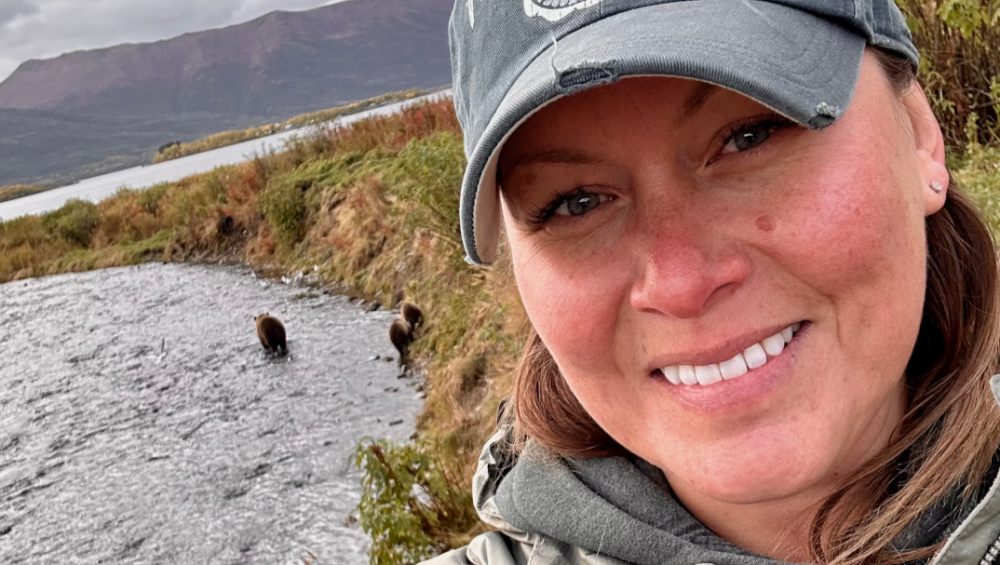
A woman taking a selfie

Welcome to My Home

Welcome to Kodiak Island Stacey Simmons

Hi, my name is Stacey (Imaq – Ocean) Simmons, and I am the Director of Operations at the Kodiak Brown Bear Center and Lodge. I truly love what I do—it’s one of the most rewarding and meaningful jobs in the world.

Let me tell you a little about our lodge.

The Kodiak Brown Bear Center and Lodge is not your typical lodge nor a wildlife sanctuary—though our name can sometimes suggest that. Owned and operated by Koniag, an Alaska Native Corporation, our lodge sits on the traditional lands of our Alutiiq ancestors, who have lived here for over 12,000 years. Most of the land we use for bear and wildlife viewing is privately owned by Koniag, which makes this an incredibly special and protected place.

As an Alaska Native-owned lodge, we weave Alutiiq culture and language into everything we do. Guests encounter this through local artwork, ongoing archeological digs at Karluk Lake, and the incorporation of traditional foods into our meals.

Our lodge hosts a maximum of eight guests at a time, providing an intimate experience where every visit directly supports our Alutiiq Shareholders. Revenue generated helps fund elder distributions, youth scholarships, cultural programs like language preservation and traditional dance, and subsistence initiatives.

We’ve also created unique opportunities for our Alutiiq youth through a hospitality training program at the lodge. Each year, young participants help prepare trails and grounds for the season, while in-season apprenticeships provide hands-on experience in hospitality and guiding. Recently, one apprentice pursued yoga training to enrich the guest experience, and another is earning certification to captain our boats eventually.

We’re a lodge with a purpose. Every guest contributes—whether they know it or not—to keeping the Alutiiq people, language, and culture alive and thriving.

Our work is work is deeply personal to me. In addition to my role at the lodge, I manage all Shareholder benefits for Koniag. Both my parents are Indigenous to Kodiak, and I grew up in one of its villages. These two roles allow me to share my home with guests, support my community, and serve as a steward of our land and culture.

It’s a privilege to work at the intersection of hospitality, cultural preservation, and sustainability. I wouldn’t have it any other way.

bear viewing and fly fishing in Alaska

Ready to discover
Kodiak?