Camp Island Alaska

The Best of 2025: A Year of Bears, Adventure, and Discovery on Kodiak Island

Visiting the Kodiak Brown Bear Center & Lodge in Alaska

As 2025 draws to a close, the snow is settling on the peaks of Kodiak Island, and our magnificent bears have tucked themselves away for their long winter rest. It has been an incredible year at the Kodiak Brown Bear Center, filled with breathtaking encounters, new discoveries, and the timeless rhythm of nature.

Throughout the year, we’ve shared stories from the field to help you understand these giants, prepare for your journey, and connect with the wild heart of Alaska. Whether you are planning a trip for 2026 or just love learning about wildlife, here is a look back at our most popular and essential blog posts from 2025.

Understanding the Giants: Bear Behavior & Biology

This year, we dove deep into what makes the Kodiak brown bear unique. These articles were favorites for those who want to move beyond the myths and understand the true nature of these animals.

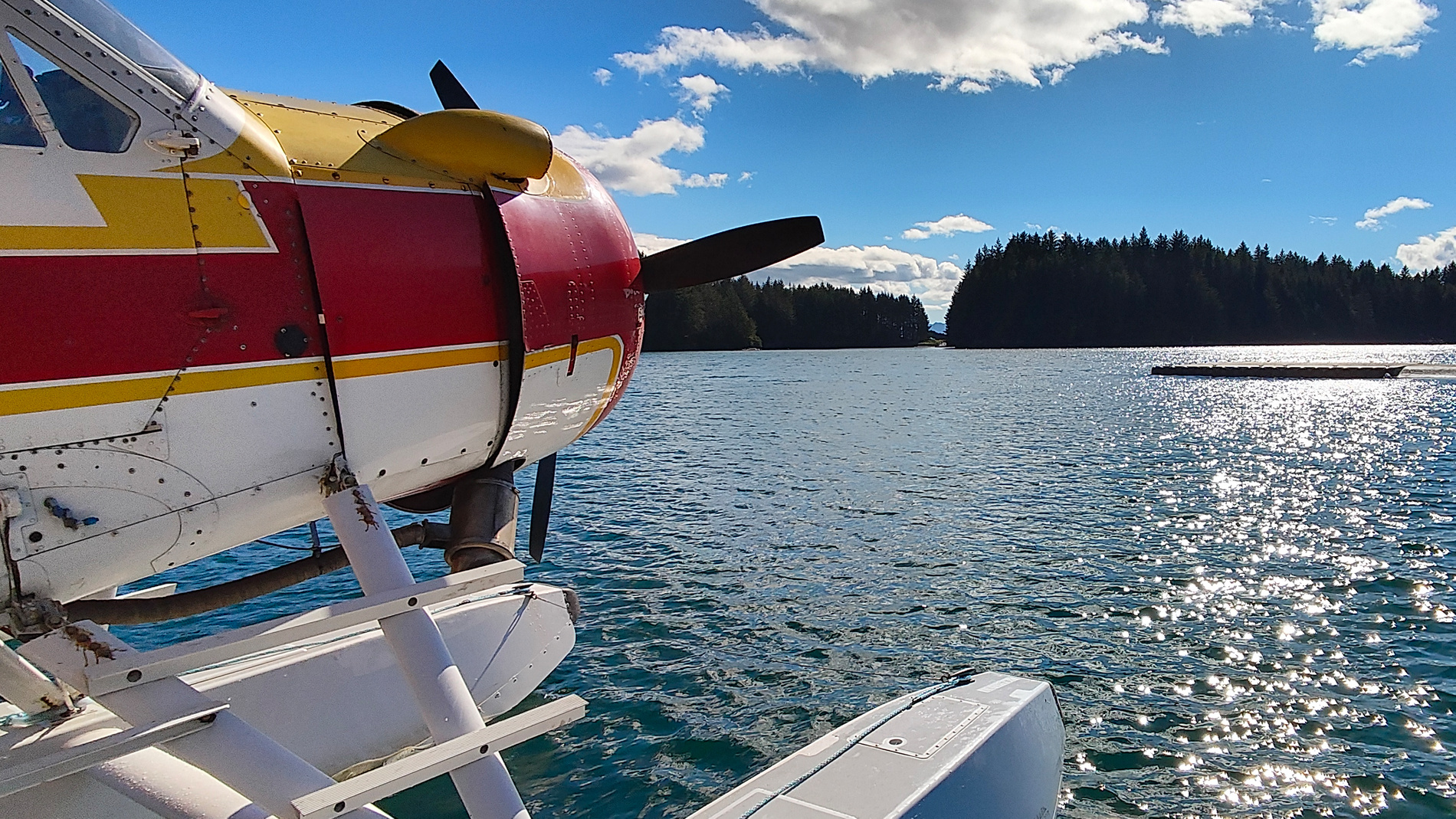
Float Plane Ready To Goto KBBC
Dan M Lee - Packing for an adventure

Planning Your Expedition: Travel & Gear

A trip to Kodiak is the adventure of a lifetime, but it requires preparation. These practical guides helped hundreds of guests arrive ready for the experience.

  • Essential Camera Gear for Bear Viewing (Nov 5) Whether you are a pro or a hobbyist, this post details exactly what lenses and bodies we recommend for capturing that perfect shot without disturbing the wildlife.

  • Mastering the Art of Floatplane Packing (July 12) Small planes mean strict weight limits. We shared our top tips for packing smart so you can bring what you need without leaving the essentials behind.

  • Your Guide to Reaching Kodiak by Air & Boat (July 6 & 8) Getting here is half the adventure. We broke down the logistics of navigating the ferry system and Alaska Airlines flights to ensure your arrival is seamless.

Life at the Lodge & Conservation

We aren’t just a lodge; we are stewards of this land. These posts gave readers a peek behind the curtain at our operations and our mission.

Photographing Kodiak Brown bears in the wild
Dan M Lee - Bear spotters in 2025

Debunking Myths

Finally, we spent time correcting common misconceptions about our favorite animals.

Thank you for being part of our journey in 2025. We can’t wait to welcome you to the lodge next year. Until then, browse the archives, dream of the wild, and have a wonderful New Year!

The Kodiak Brown Bear Center Team

bear viewing and fly fishing in Alaska

Ready for an adventure?

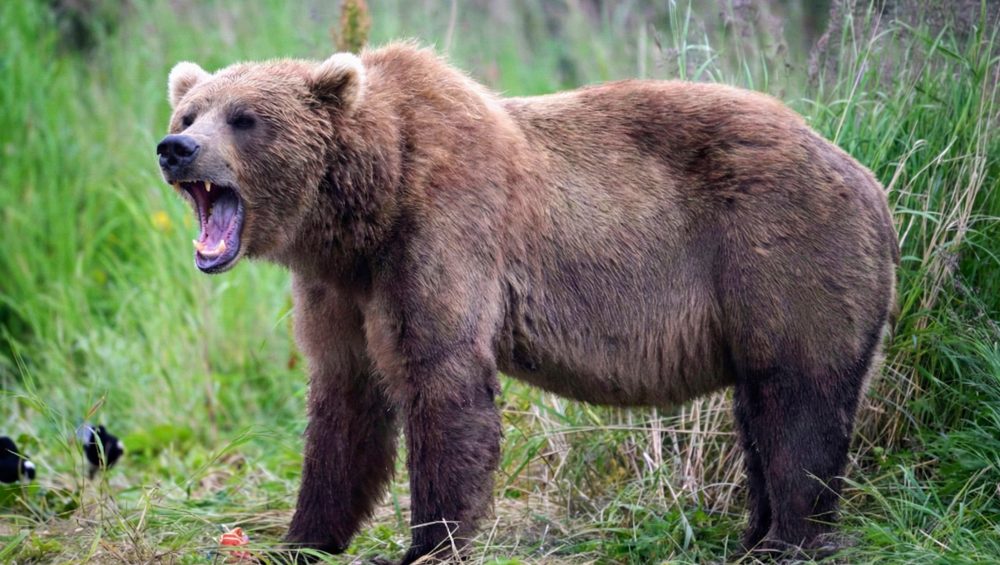
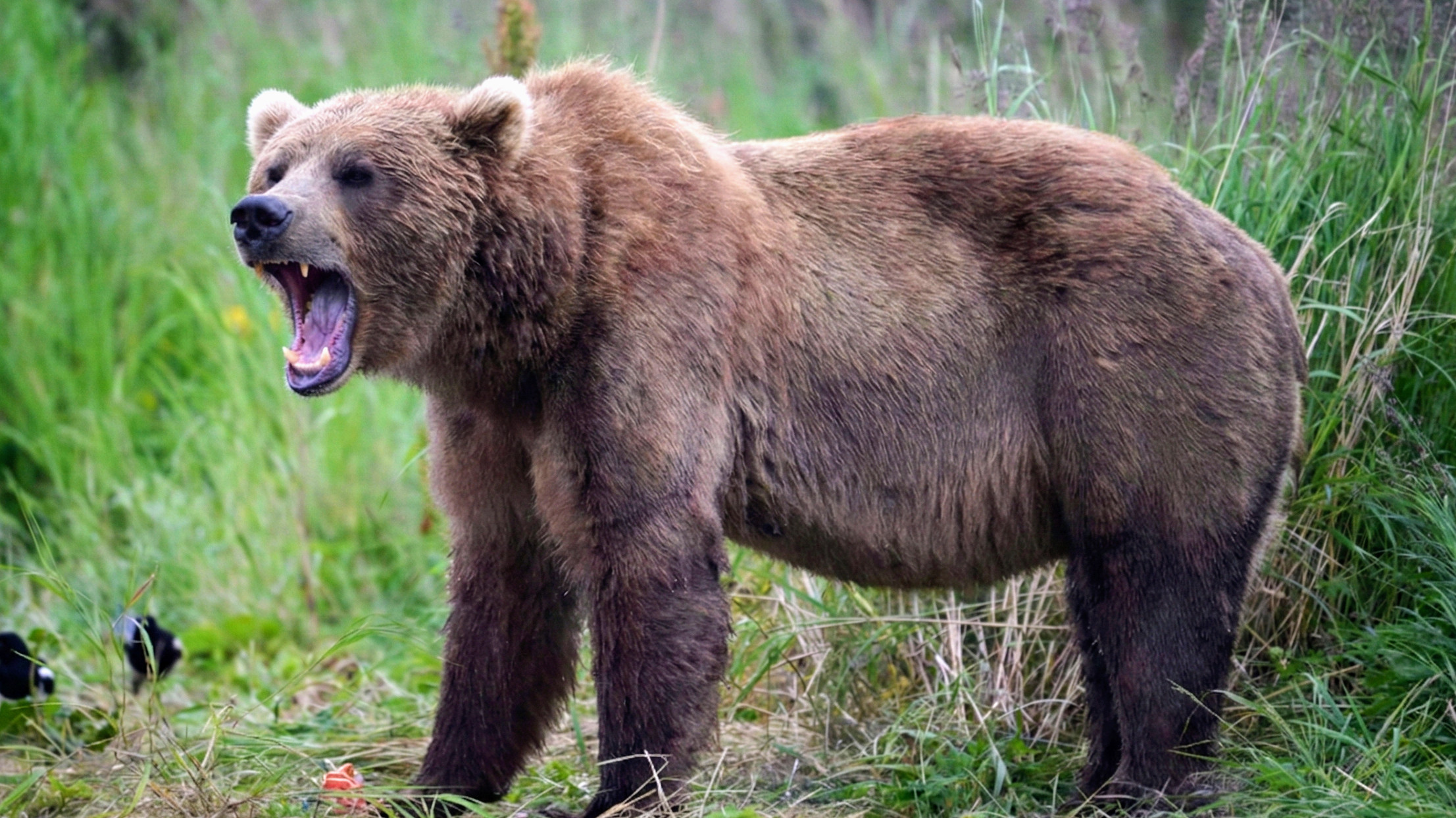
A large brown bear stands in tall grass with its mouth open wide, showing its teeth as if growling or roaring. Lush green vegetation surrounds the bear in a natural outdoor setting.

A Guide to Decoding the Silent Language of Kodiak’s Giants

A Kodiak brown bear stands in a grassy stream on the right. On the left, orange text reads “Kodiak Brown Bear Center Lodge” above a bear paw print logo.

When most people imagine a bear communication, Hollywood fills their mind with thunderous roars and gnashing teeth. But here on Kodiak Island, the reality is far more subtle—and arguably more fascinating.

As wildlife enthusiasts (and I a wildlife photographer), we often spend hours observing Kodiak brown bears on the Karluk River and surrounding inlets. The key to a truly safe and enriching experience isn’t just seeing the bear; it’s understanding what the bear is saying.

Kodiak brown bears are masters of non-verbal communication, using a complex vocabulary of postures, ear positions, and subtle movements to navigate their social hierarchy without unnecessary conflict.

If you are preparing for your trip to the Kodiak Brown Bear Center, here is a guide to deciphering the silent language of the giants.

All Ears

One of the quickest ways to gauge a bear’s mood is to look at its ears.

Perked Forward: A bear with ears pricked forward is curious and engaged. They are gathering information about a sound or a scent. This is generally a calm, attentive state.

Pinned Back: This is a universal sign of stress or aggression in the animal kingdom, and bears are no exception. Ears flattened against the skull indicate the bear is feeling defensive, agitated, or threatened. If you see this through your lens, it’s time to slowly back off and give them space.

5 myths about bears-busted
Dan M Lee - Ears Forward, Engaged

The "Stress Yawn"

In the human world, a yawn means we are tired or bored (well the most supported theory is that yawning helps cool the brain, anyway I digress). In the bear world, a yawn in the middle of a social interaction often means the opposite: high tension.

We often see this when a sub-adult bear finds themselves too close to a dominant boar. The younger bear might sit down and let out a wide, exaggerated yawn. They aren’t sleepy; they are venting anxiety. It’s a displacement behavior that essentially signals, “I am uncomfortable with this situation, and I’m trying to calm down.”

That’s not to say bears do not yawn when they are tired, as they do, just like humans.

The Cowboy Walk

My favorite behavior to observe, but it could mean trouble.

If you see a large male walking with a stiff-legged, rolling gait—legs spread slightly wider than usual—you are witnessing a display of dominance.

We often call this the “cowboy walk.” By stiffening their legs and moving deliberately, the bear is maximizing its height and presence, signaling to other bears (and us) that he is the boss of this stretch of river.

A photographer captures this perfectly from the Kodiak bears cousin, the Coastal brown bear, which exhibit the same behavior traits

A large brown bear stands in tall grass with its mouth open wide, showing its teeth as if growling or roaring. Lush green vegetation surrounds the bear in a natural outdoor setting.
Dan M Lee - Yawning Kodiak bear

Jaw Popping and Huffing

While bears are generally quiet, they do have a specific sound for “back off.” If a bear is surprised or feels crowded, it may expel air rapidly in a “huff” or snap its jaws together to create a loud popping sound.

This isn’t usually a prelude to an attack, but rather a clear warning. It is the bear’s way of saying, “You are in my personal space, and I don’t like it.” Our guides are experts at listening for these cues to ensure we maintain a respectful distance that keeps the bears relaxed.

Avoidance is Key

Perhaps the most common “interaction” you will see is avoidance. Kodiak bears are generally conflict-averse.

You will often watch a sow with cubs spot a large male 200 yards away and immediately alter her path to circle wide around him.

This isn’t fear so much as a calculated survival strategy. Understanding these subtle diversions helps us predict where a bear might move next, allowing us to remain safe at all times.

Learning to “speak bear” transforms a viewing trip. You stop seeing just a “big animal” and start seeing a sentient creature with moods, boundaries, and intentions.

It reminds us that we are guests in their home. By listening to their silent language, we show them the respect they deserve—and in return, they grant us a glimpse into their wild, unguarded world.

bear viewing and fly fishing in Alaska

Ready for an adventure?

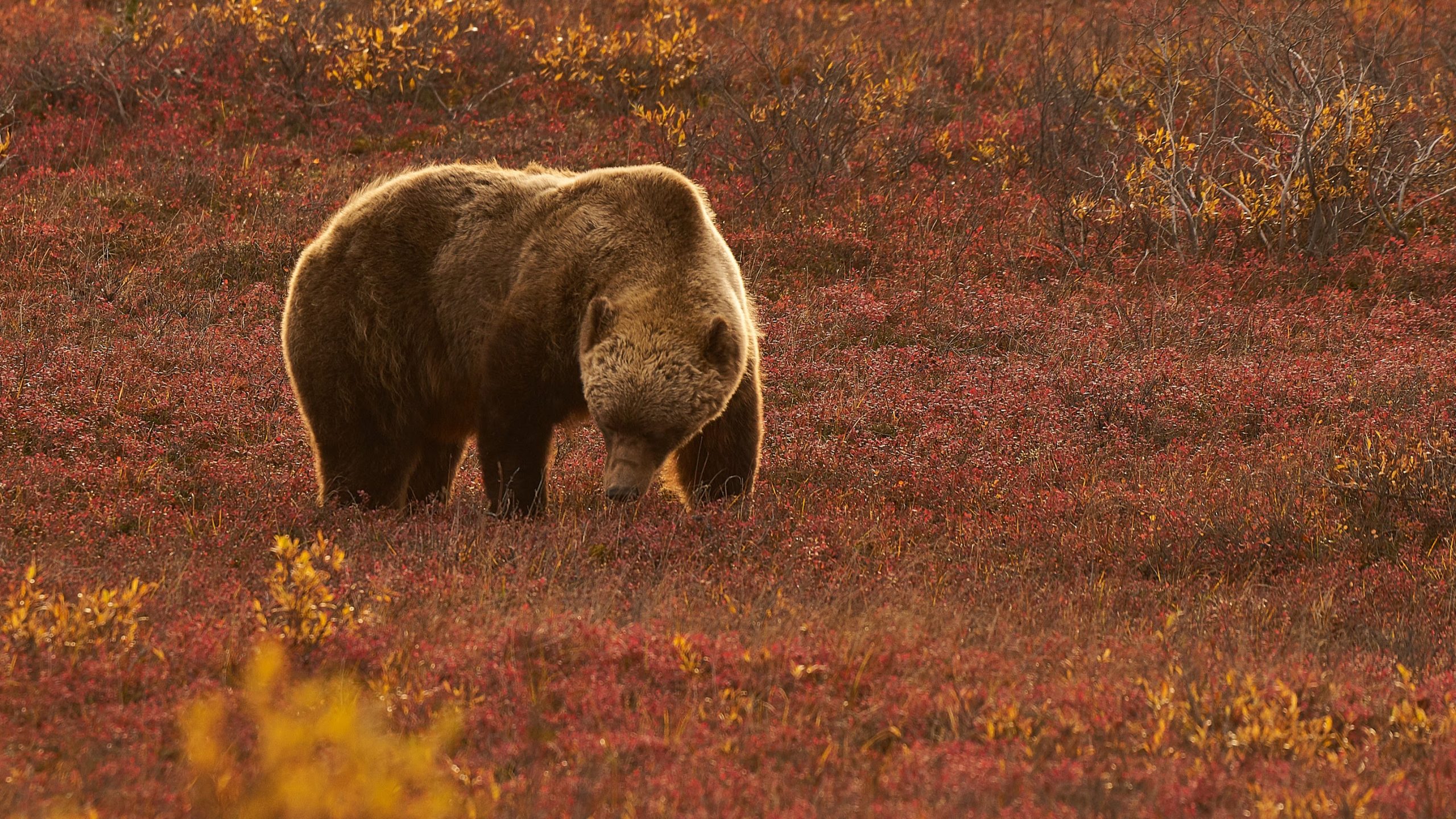
A brown bear with a thick fur coat walks through a field of low, reddish vegetation and autumn foliage, its head down as if foraging. The scene is bathed in warm, natural light.

The Mighty Kodiak Bear: Exploring the Weight and Power of Nature’s Giants

A brown bear stands in a stream surrounded by green foliage. On the left, orange text reads Kodiak Brown Bear Center Lodge above an orange bear paw print graphic.

On Kodiak Island, where misty mountains rise above salmon-filled rivers, the Kodiak brown bear reigns as one of nature’s true giants. Known for its impressive strength and sheer size, this subspecies of brown bear (Ursus arctos middendorffi) has fascinated wildlife enthusiasts, photographers, and scientists for decades.

But just how heavy are these bears—and how do they compare to others around the world?

The Massive Weight of the Kodiak Brown Bear

Kodiak bears are among the largest omnivores on Earth. Adult males typically weigh 800 to 1,200 pounds (360–545 kg), with some exceptional individuals exceeding 1,500 pounds (680 kg) in late summer and fall when they’ve fattened up for hibernation. Females are smaller, usually ranging from 400 to 700 pounds (180–320 kg).

The key to their size lies in abundance. Kodiak Island’s ecosystem provides a feast—salmon runs, lush vegetation, and access to coastal food sources allow these bears to reach their record-breaking weights without needing to compete with other large predators.

How Kodiak Bears Compare to Other Bear Species

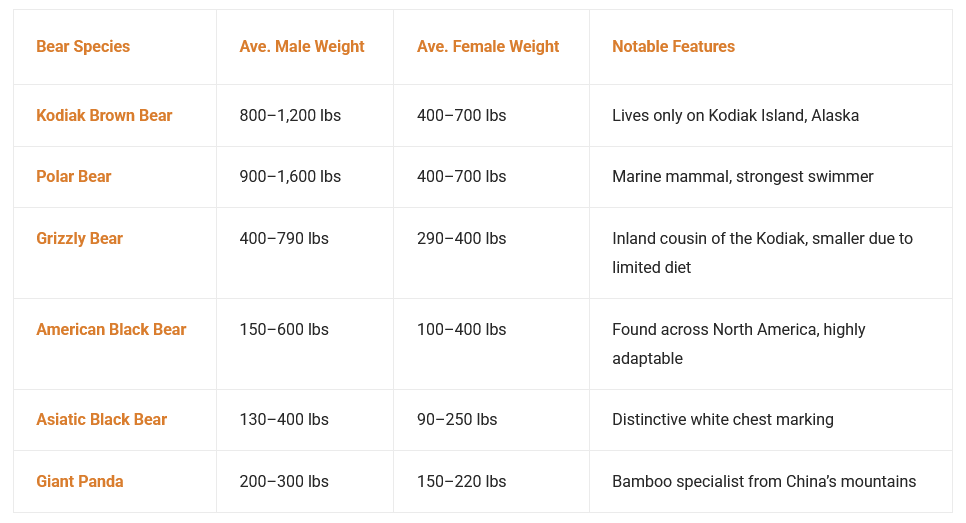
While the Kodiak bear often takes the title of “largest bear,” it actually shares that honor with another heavyweight—the polar bear.The Kodiak bear is the largest brown bear, the polar bear the largest of all.

Bear SpeciesAve. Male WeightAve. Female WeightNotable Features
Kodiak Brown Bear800–1,200 lbs400–700 lbsLives only on Kodiak Island, Alaska
Polar Bear900–1,600 lbs400–700 lbsMarine mammal, strongest swimmer
Grizzly Bear400–790 lbs290–400 lbsInland cousin of the Kodiak, smaller due to
limited diet
American Black Bear150–600 lbs100–400 lbsFound across North America, highly
adaptable
Asiatic Black Bear130–400 lbs90–250 lbsDistinctive white chest marking
Giant Panda200–300 lbs150–220 lbsBamboo specialist from China’s mountains
A table compares six bear species by average male and female weights and notable features. Species listed: Kodiak Brown, Polar, Grizzly, American Black, Asiatic Black, and Giant Panda.

Although polar bears can sometimes edge out Kodiaks in sheer weight, Kodiak bears are generally bulkier in build. Their powerful shoulders and heavy frames reflect a life of digging, foraging, and defending territory on solid ground.

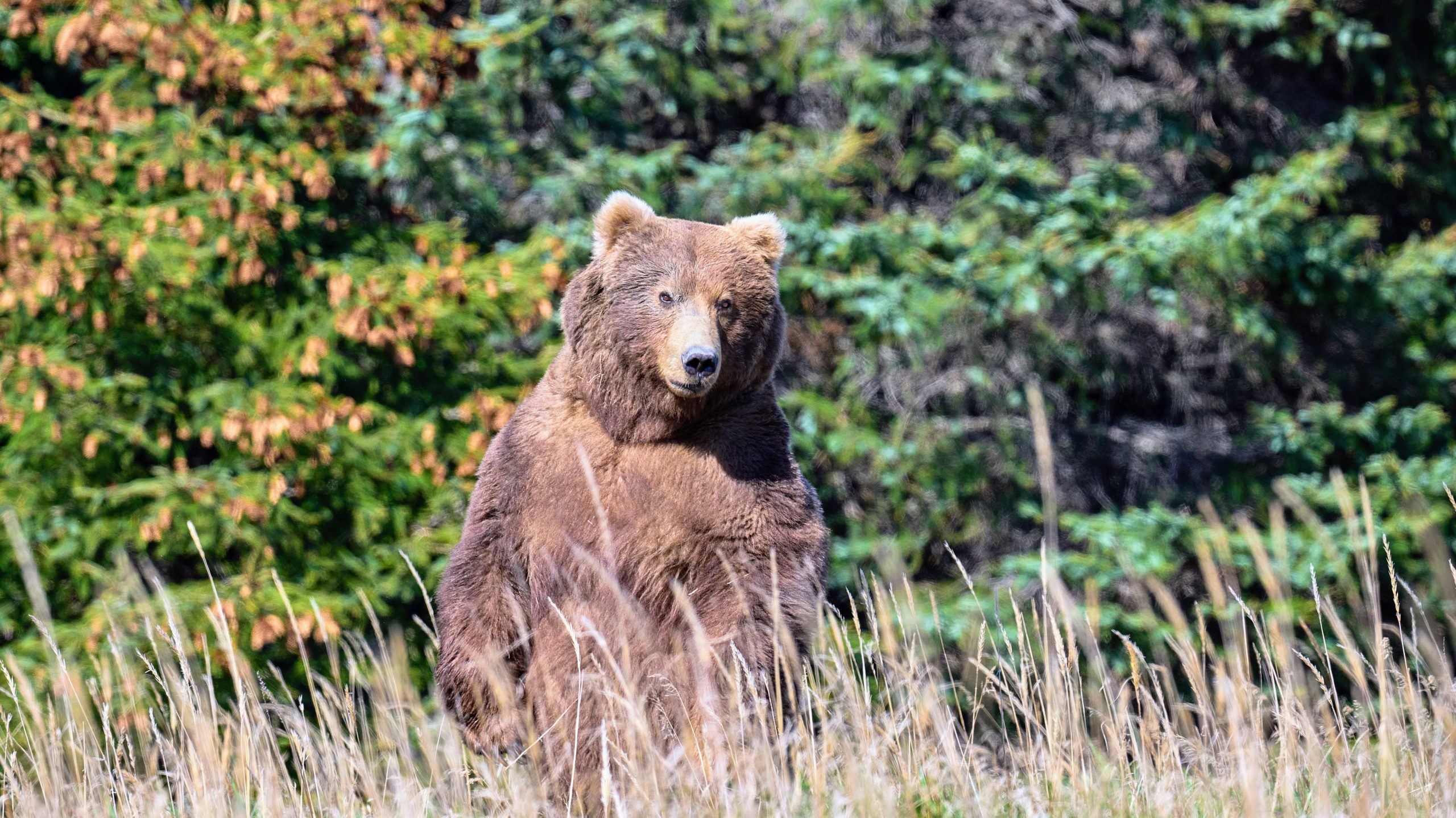
kodiak brown bear on back legs standing up
Dan M Lee - Kodiak Bear Standing 8ft Tall

Seasons of Change: How Weight Fluctuates Throughout the Year

Kodiak bears live by the rhythm of the seasons. In spring, after emerging from hibernation, they’re at their leanest. As summer progresses and salmon fill the rivers, their bodies rapidly recover. By late autumn, these bears have gained hundreds of pounds—sometimes adding up to 30% of their body weight in preparation for the long Alaskan winter.

This cycle is critical for survival. A well-fed Kodiak bear can endure months of hibernation without eating, living off stored fat until spring’s thaw signals the return of abundance.

A brown bear with a thick fur coat walks through a field of low, reddish vegetation and autumn foliage, its head down as if foraging. The scene is bathed in warm, natural light.
Dan M Lee - Smaller "Grizzly" Bear

Witnessing the Giants Firsthand

There’s nothing quite like seeing a Kodiak bear in person. Standing within the wild heart of Alaska, surrounded by the scent of spruce and sea air, you understand why these animals inspire awe. Their power is matched only by their calm confidence—a presence that commands respect without aggression.

For those who visit the Kodiak Bear Center, these encounters are not just sightings—they’re moments of connection. Each observation helps deepen our understanding of these magnificent animals and supports ongoing conservation efforts that ensure future generations will know the giants of Kodiak Island.

bear viewing and fly fishing in Alaska

Ready for an adventure?

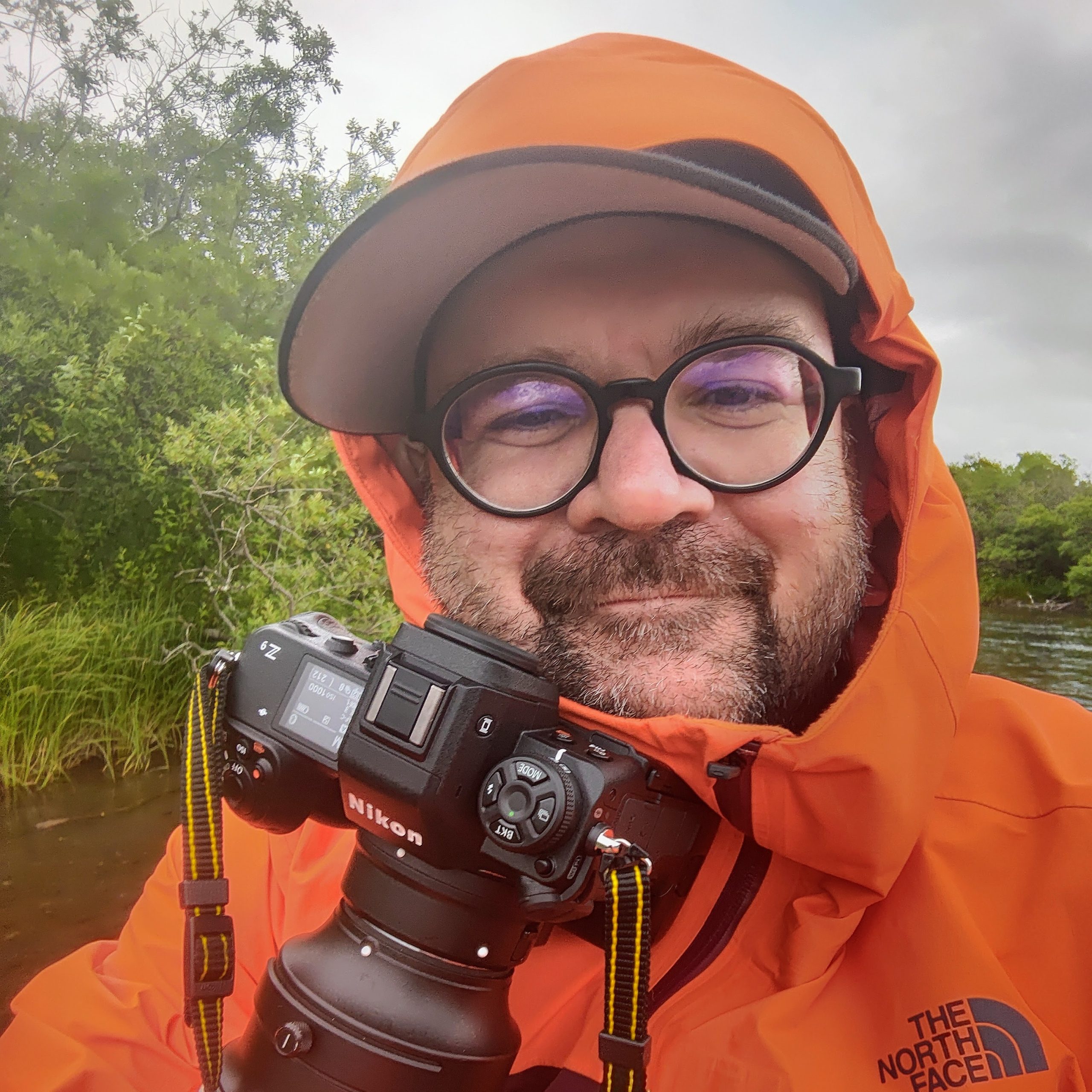
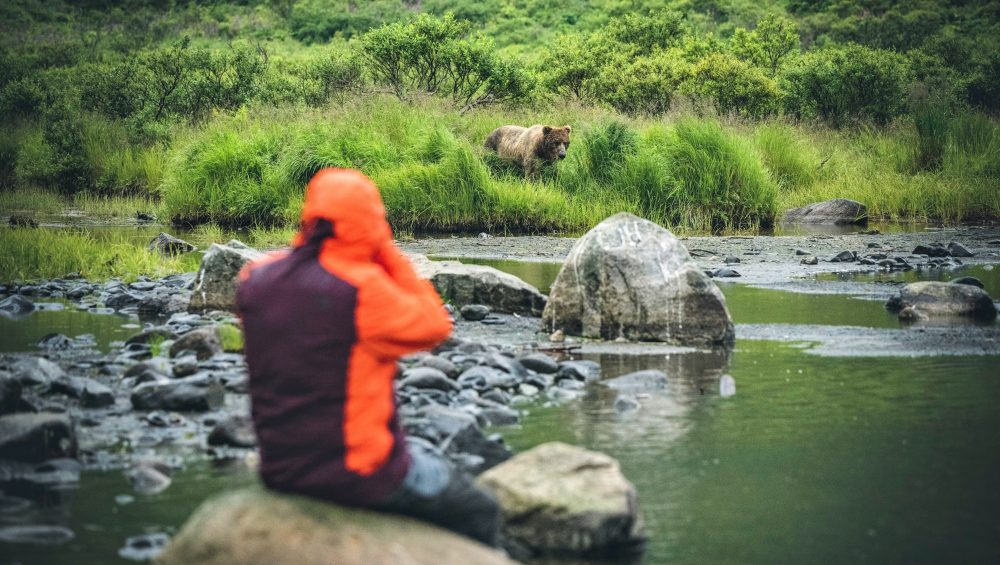
Dan M Lee in an orange jacket sits on rocks near a riverbank, photographing or observing a brown bear in the grass across the water, surrounded by green vegetation.

Essential Camera Gear for Bear Viewing

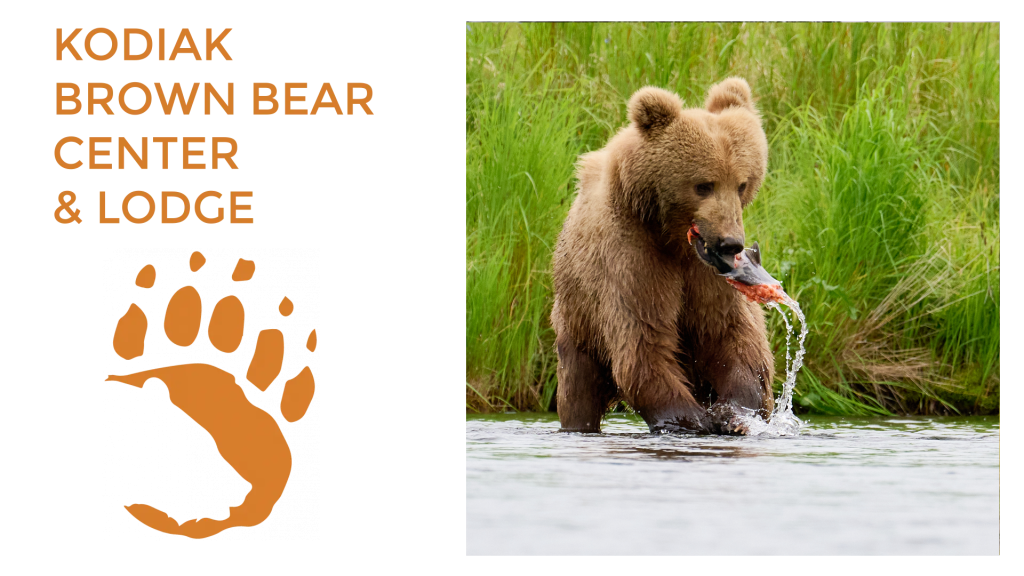
A brown bear stands in a river, catching a fish in its mouth. On the left, orange text reads Kodiak Brown Bear Center Lodge above a bear paw print graphic. Green grass is visible in the background.

You’ve booked the trip. You’re coming to Kodiak. You are ready to see the island’s magnificent bears, and you want the photos to prove it. But one look at a camera forum and your head is spinning: teleconverters, mirrorless, F-stops… it’s a lot.

Let’s cut through the noise.

While your camera body is important, the glass you put in front of it is what will make or break your photos. You don’t need a bag stuffed with 10 different lenses. For a beginner coming to view wildlife, you can cover 99% of your shots with just three.

Here’s a direct, no-fuss guide to the three lenses you should pack for your bear viewing adventure

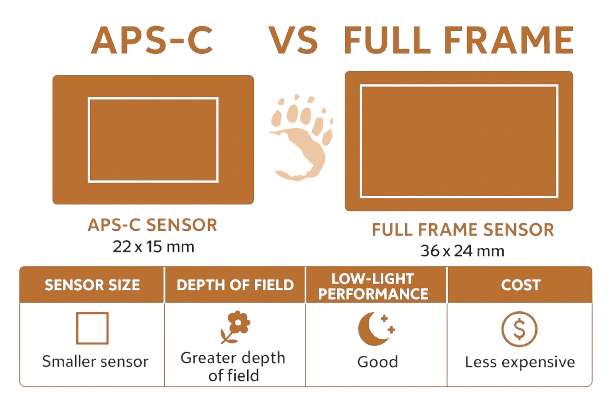
A Quick Detour: Full Frame vs. Crop Sensor

Before we list the lenses, we have to talk about this. It’s the one bit of technical jargon you need to know.

  • Full Frame: The camera’s sensor (the “digital film”) is bigger. It’s great in low light and captures a wider scene. 35mm film size if you are of the older generation.

  • APS-C (Crop Sensor): The sensor is smaller. This is not a “worse” thing; it’s just different. In fact, for wildlife, it can be a secret weapon.

Why? Because the smaller sensor “crops” the image, it effectively magnifies your lens. This is called the “crop factor.” A 300mm lens on an APS-C camera acts more like a 450mm lens. You get 1.5x (or 1.6x) more “zoom” for free! You can put a Full Frame camera into “crop mode” which is the same thing.

For this list, we’ll talk about lens focal lengths in their standard (full-frame) terms. Just remember, if you have a crop sensor, you’re getting even more reach!

Comparison chart showing APS-C 22 x 15 mm vs Full Frame 36 x 24 mm sensors with icons indicating APS-C is smaller, has greater depth of field, and is less expensive; Full Frame has better low-light performance.
Benefits of APS-C "Crop Sensor"

The Big Gun: The 100-400mm (or 150-600mm)

This is your real wildlife lens. This is how you get those frame-filling shots.

Let’s be direct: You will be viewing bears from a safe distance. Park regulations and simple common sense demand it. You will not be (and should not be) close enough to get a headshot with your phone.

A lens in the 100-400mm or 150-600mm range is the new beginner standard. It gives you the “reach” you need to fill your frame with a bear that is way, way over there. These “super-telephoto” zooms are sharp, relatively affordable, and let you get the shot without ever disturbing the wildlife (or becoming its lunch). This is the lens that will likely spend the most time on your camera.

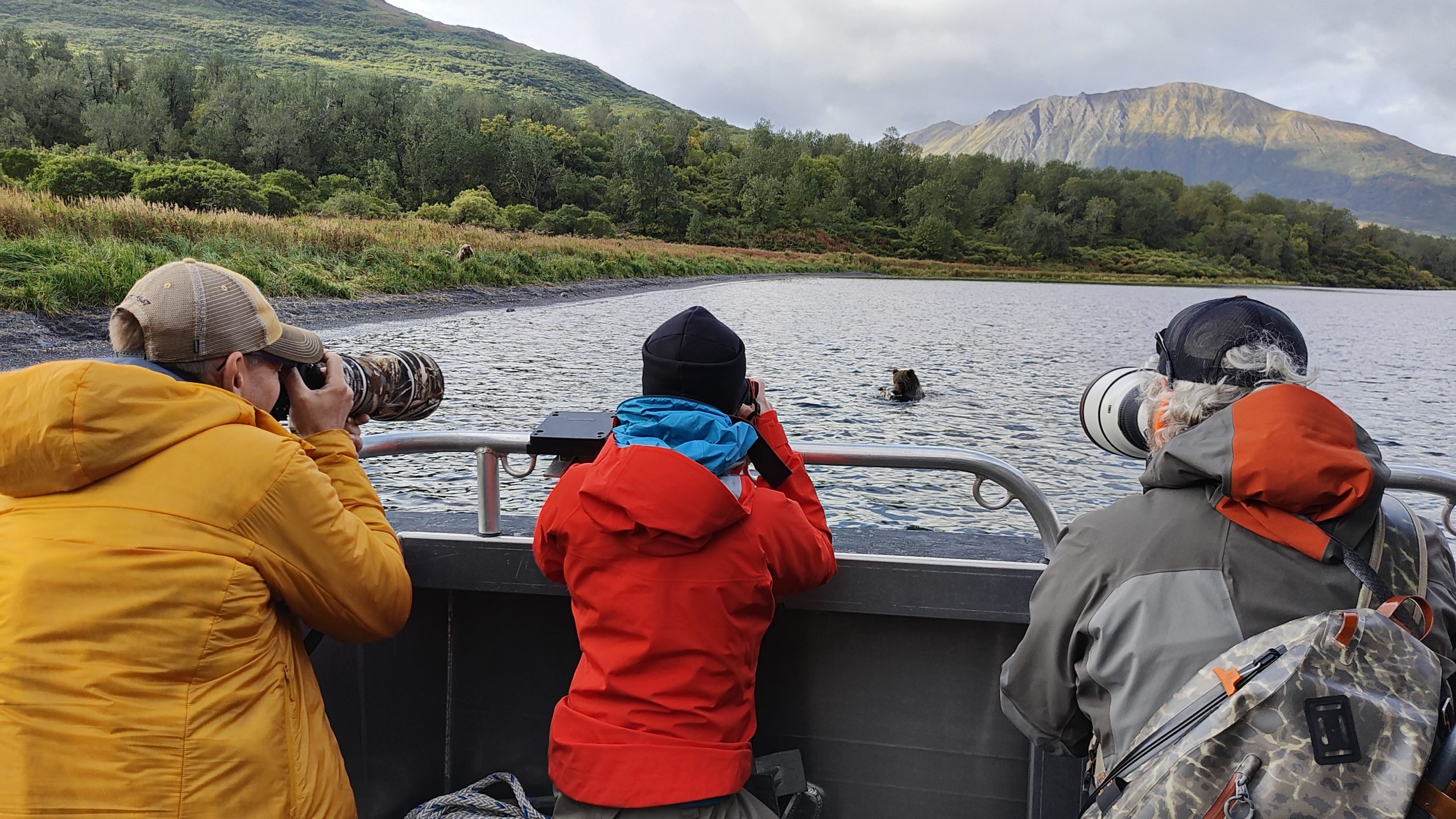
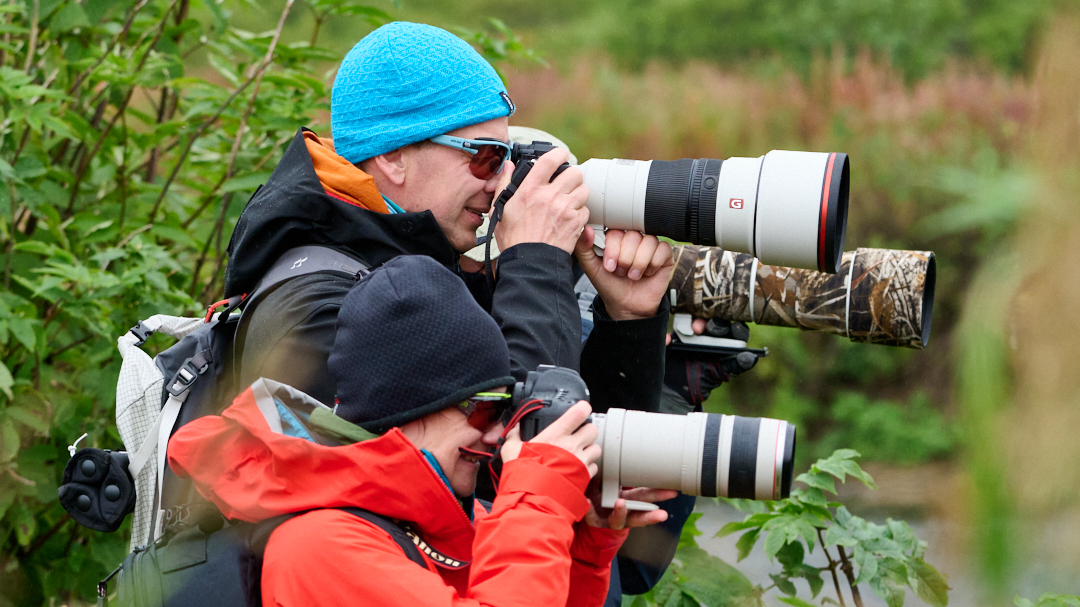
Two people wearing colorful jackets and hats hold cameras with large telephoto lenses, aiming them forward while standing in a lush, green outdoor setting. Taken by Dan M Lee
Dan M Lee - Big Lenses

The Storyteller: The 24-70mm (or 16-35mm)

A wide-angle lens? For wildlife? Absolutely.

You are not just here to photograph a bear; you are here to photograph a bear in Kodiak. The landscape is just as much a character in your story.

When a bear is a distant speck on the beach, don’t put your camera away. Put on your wide-angle lens. Use it to capture the epic scale of the mountains, the dramatic coastal weather, and the sheer vastness of the bear’s world. A photo of a small bear in a huge, beautiful landscape tells a more powerful story than a simple close-up. This lens is for capturing the “sense of place.”

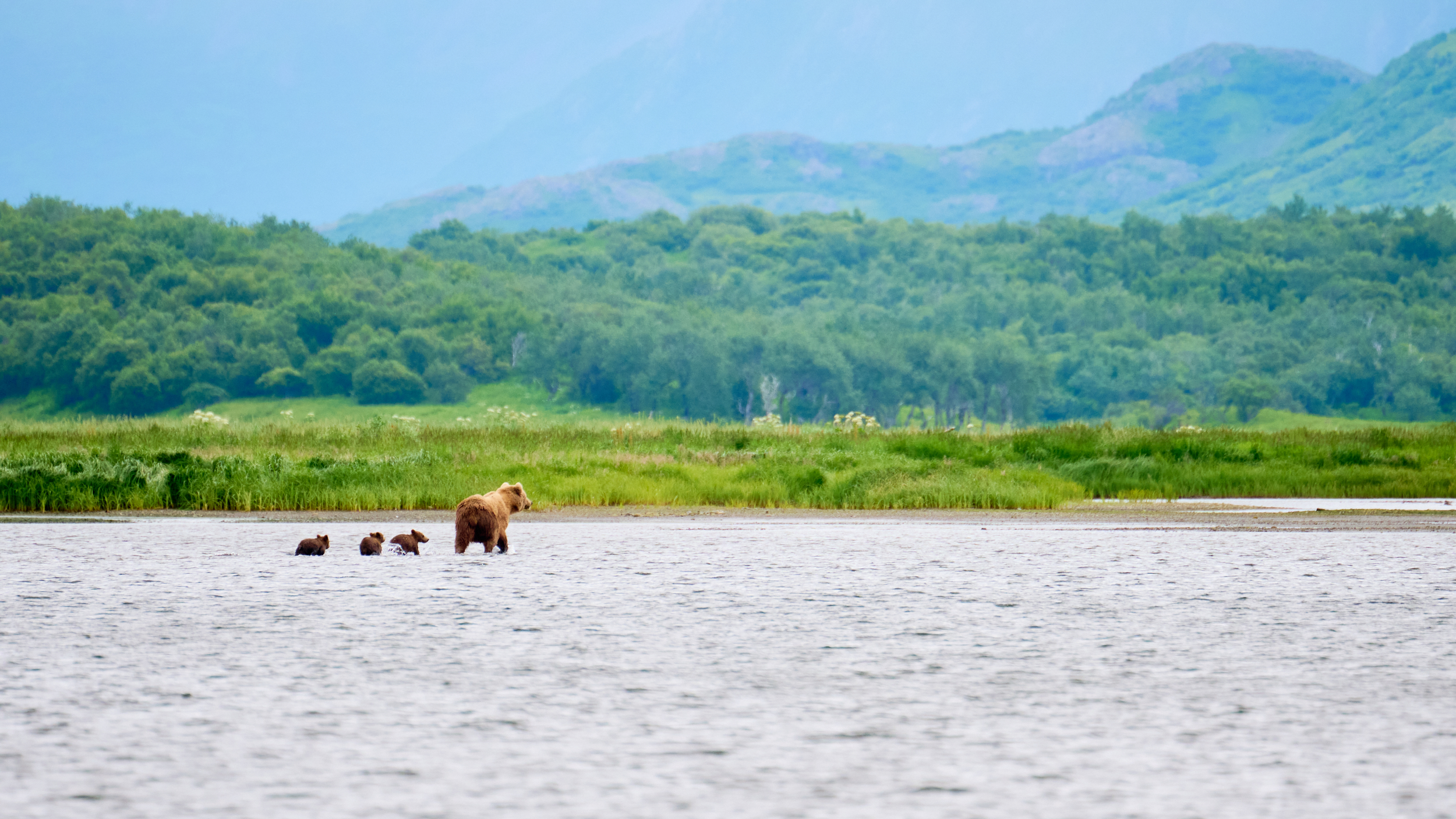
A brown bear with three cubs walks through shallow water, surrounded by lush green vegetation and distant mountains on a cloudy day.
Dan M Lee

The Workhorse: The 70-200mm Zoom

This is your “all-rounder” lens. It’s a classic for a reason.

A 70-200mm lens is versatile. It’s wide enough at 70mm to capture a bear within its environment—maybe walking along the shoreline with mountains in the background. At 200mm, it’s sharp and powerful enough to get a lovely half-body portrait when you have a good (but safe!) view.

If you can spring for the f/2.8 version, it’s amazing in the cloudy, low-light days we often get on Kodiak. But don’t sleep on the f/4 versions—they are significantly lighter, cheaper, and still incredibly sharp.

Photography Worshops

That’s it. A workhorse zoom, a big telephoto for reach, and a wide-angle for story. With these three lenses, you are prepared for almost any situation Kodiak throws at you. One last thing, don’t forget some high powered, lightweight binoculars. 

Want to really learn how to use those lenses? I can help with that. I’m Dan M. Lee, and I run award-winning photography workshops right here at the lodge.

When I’m not writing for publications like Digital Camera World, I’m out here helping guests get the shot of a lifetime. Look out for my workshop dates; it’s a fantastic way to take your new gear and your skills to the next level.

bear viewing and fly fishing in Alaska

Ready for an adventure?

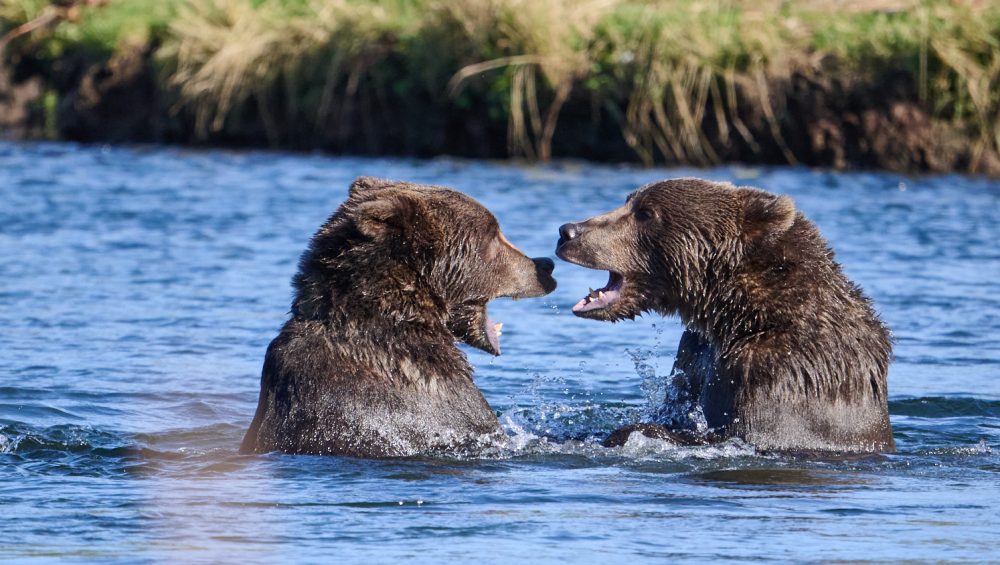
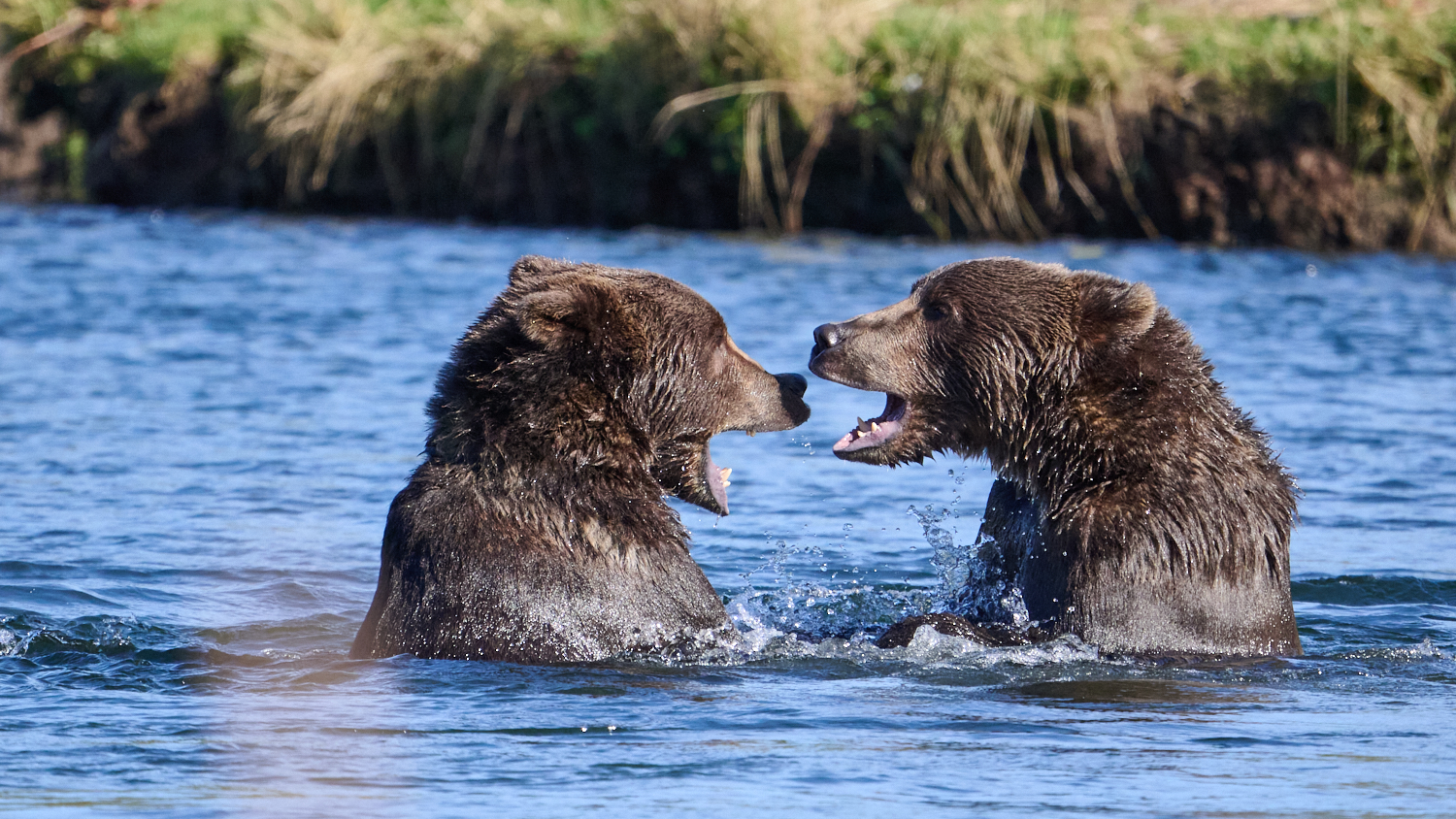
Two brown bears stand face to face in shallow water, mouths open as if playfully sparring or communicating. Splashes surround them and green grass lines the riverbank in the background.

The Great Separation: A Young Kodiak Bears Journey to Independence

Two brown bears stand upright, playfully sparring in a river. To the left, orange text reads “Kodiak Brown Bear Center Lodge” above an orange bear paw print graphic. Green foliage is in the background.

For the first two to three years of his life, a male Kodiak brown bear cub lives a relatively sheltered existence under his mother’s protection. He learns what to eat, where to fish, and how to navigate the complex social world of bears. But this vital apprenticeship always comes to an abrupt end. When the sow (mother bear) enters estrus and prepares to mate again, her behavior shifts, and she will aggressively chase off her young, forcing them to face the world alone.

For a young male, this “great separation” is the single most dangerous turning point of his life.

Independence

Suddenly independent, the “sub-adult” male faces two immediate challenges: food and safety. He must now find all his own meals, from digging up roots and grazing on spring sedges to catching the high-calorie salmon of mid-summer. But a far greater danger is other bears.

His primary survival strategy is avoidance, especially of large, dominant adult boars. These massive males, which can weigh over 1,200 pounds, view young, independent bears not just as rivals, but often as a potential food source.

The young male must live in the margins, forced to use less productive habitats and fish at odd times, always looking over his shoulder.

Ages 3-8 for a Young Male Bear

This “sub-adult” phase, lasting from roughly age 3 to 8, is the bear’s adolescence. He is no longer a cub, but he is far from a dominant boar. During this time, he focuses purely on growing and learning.

Young bears will test his strength against bears his own size and may even form temporary alliances with other sub-adults, sometimes his own siblings, traveling and playing together for short periods. This play is crucial practice for the fights that will define his adult life.

He learns the landscape, memorizing the best berry patches and the safest routes, gradually building the strength and experience needed to survive.

Two brown bears stand face to face in shallow water, mouths open as if playfully sparring or communicating. Splashes surround them and green grass lines the riverbank in the background.
Dan M Lee - 2 Juvenile bears play, just before mum cuts them loose

Solitary King

A male Kodiak bear doesn’t reach his full physical and social maturity until he’s 9 or 10 years old. His entire sub-adult life is a quest to survive long enough to achieve the immense size required to compete.

Only then can he hold his own home range, secure access to the best fishing spots, and finally participate in the breeding hierarchy.

This harsh transition from dependent cub to solitary king is a dramatic trial by fire, ensuring only the most resilient and powerful bears shape the next generation of Kodiak giants.

Why not come and see for yourself, visit the Kodiak Brown Bear Center and experience the true Alaska.

bear viewing and fly fishing in Alaska

Ready for an adventure?

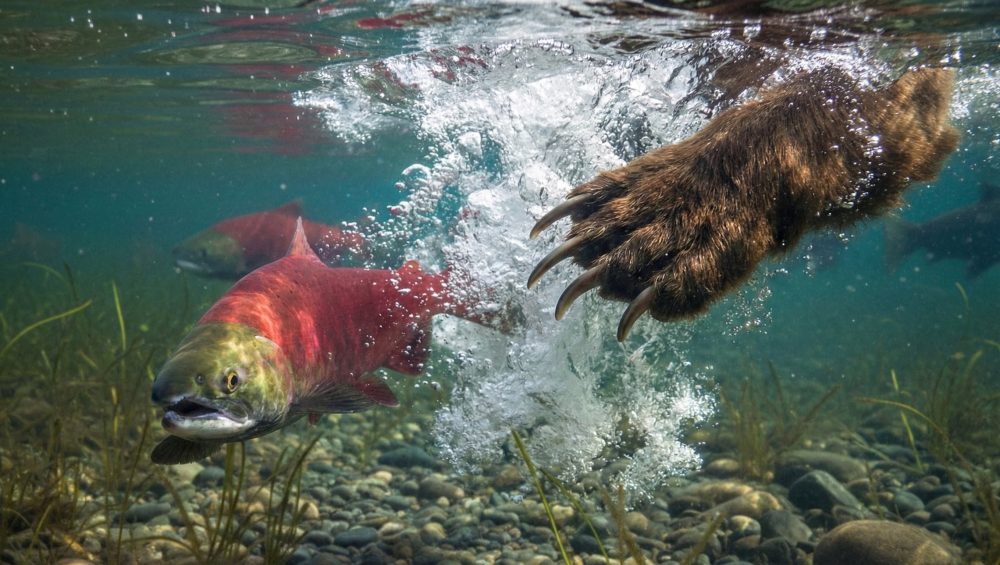
sockeye Salmon in an Alaskan river

Why Salmon are the Lifeblood of Kodiak Island

A graphic for Kodiak Brown Bear Center Lodge features a brown bear paw print and text on the left, with a photo of a red-hued salmon swimming underwater on the right.

On Kodiak Island, every stream, river, and lake pulses with an ancient rhythm. It’s the rhythm of salmon. Each year, a silver tide of five different species of Pacific salmon returns from the ocean to the freshwater streams of their birth. This epic journey, culminating in the ultimate sacrifice, is more than just a spectacle; it is the foundational event that fuels nearly all life on the Emerald Isle, earning salmon the title of Kodiak’s true lifeblood.

The Great Annual Feast

The most visible impact of this migration is the frenzied feast it provides. As summer wanes, Kodiak brown bears congregate along the rivers, expertly hunting the nutrient-rich fish. The high-fat content of salmon is the critical fuel they need to build reserves for the long winter hibernation. But the bears are not alone.

Bald eagles, gulls, and river otters join the banquet, relying on this seasonal bounty for their own survival and to raise their young.

This explosion of life, centered on the returning salmon, is one of the most powerful and dramatic scenes in the natural world.

sockeye Salmon in an Alaskan river

Fertilizing the Forest

However, the salmon’s most profound gift is one that is largely unseen. As a keystone species, their influence extends deep into the forest itself. Salmon spend years in the ocean, accumulating nutrients from the sea. When they return to Kodiak and die after spawning, they bring a massive influx of marine-derived nitrogen and phosphorus with them. This is where the bears play an unexpected role as nature’s gardeners. By dragging salmon carcasses from the riverbanks deep into the woods, they directly fertilize the soil.

Scientific studies have traced this marine nitrogen from the salmon into the foliage of the Sitka spruce, alders, and shrubs lining the streams, making the land more lush and productive.

An Interconnected Ecosystem

From the fattened bears and soaring eagles to the enriched soil and thriving forests, the entire ecosystem is woven together by the life cycle of the salmon. They are the irreplaceable link between the vast, nutrient-rich ocean and the terrestrial world of the island.

This annual migration is not just a food source; it is a massive transfer of energy that underpins the health, vibrancy, and wild spirit of Kodiak Island, Alaska.

It is nature’s perfect, powerful cycle, and it is the beating heart of the island.

bear viewing and fly fishing in Alaska

Ready for an adventure?

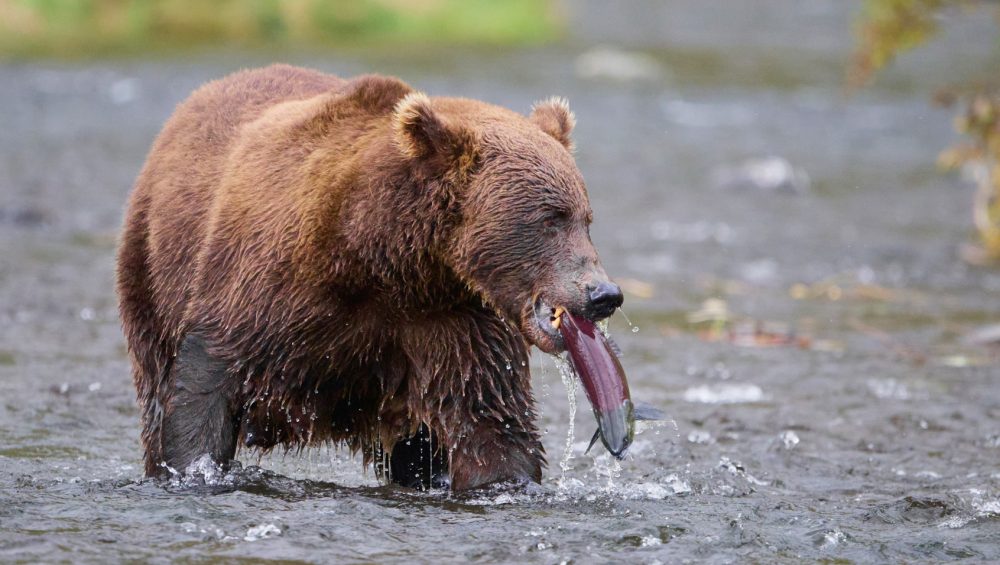
A brown bear stands in a river with water splashing around its legs, holding a large fish in its mouth. The bear’s fur is wet and the background is blurry, showing more water and greenery. Taken by Dan M Lee

Kodiak vs. Grizzly: Same Bear, Different Name?

kodiak vs grizzly bears what's the difference

It’s a common question for wildlife enthusiasts: is a Kodiak bear just a really big grizzly? The answer lies in genetics, geography, and diet. While they are closely related, there are important distinctions that set them apart.

The Scientific Classification

Both Kodiak bears and grizzly bears belong to the same species: the brown bear (). The key difference is that they are separate subspecies.


  • Grizzly Bear: The bears found across mainland North America are classified as Ursus\;arctos\;horribilis.

  • Kodiak Bear: The bears found exclusively on the islands of the Kodiak Archipelago in Alaska are classified as Ursus\;arctos\;middendorffi.

Think of it like Labradors and Golden Retrievers. Both are the same species (dog), but they are different breeds (subspecies) with distinct characteristics.

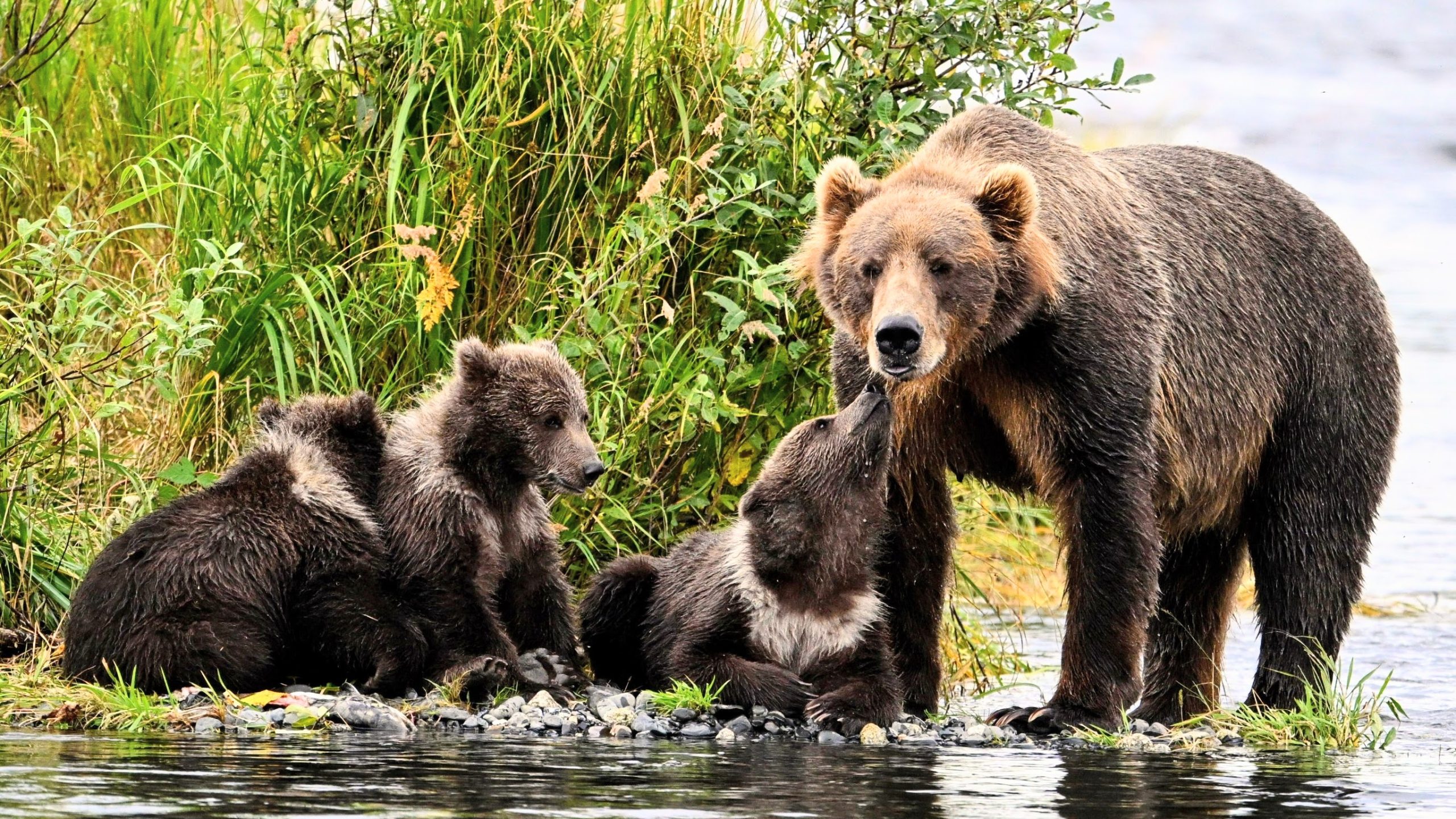
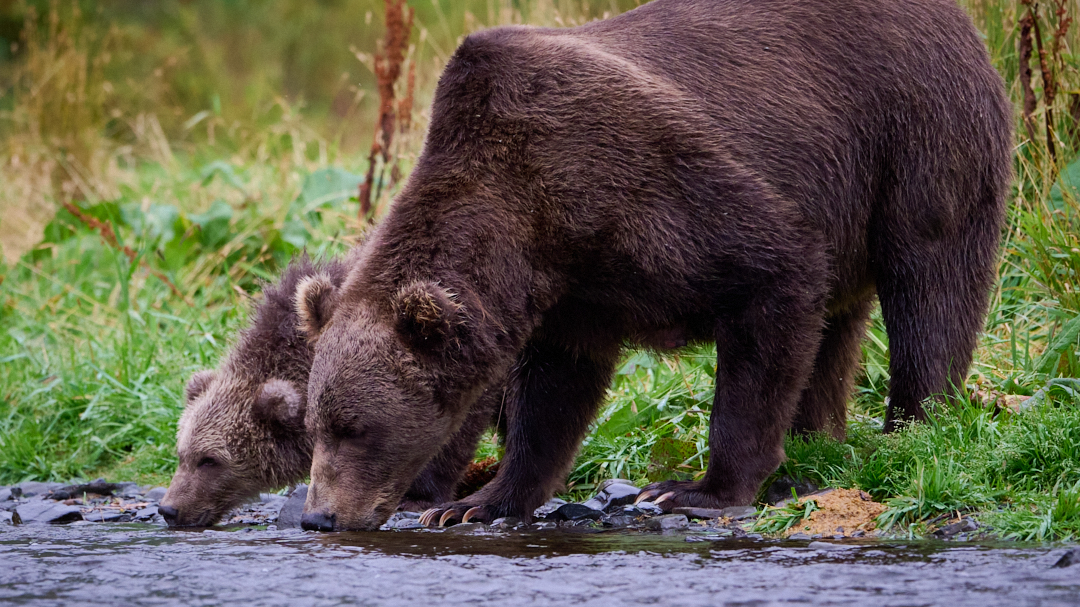
A brown bear and its cub stand at the edge of a river, bending down to drink water, surrounded by green grass and plants. Taken by Dan M Lee
Dan M Lee

Why the Difference? Isolation and Diet

The primary reason for the separate classification is geographic isolation. The Kodiak bear population has been isolated from their mainland cousins for about 12,000 years, ever since the last ice age separated the islands from the mainland.

This isolation, combined with a uniquely rich and abundant food source, has driven their evolution. The Kodiak Archipelago offers a diet heavy in fatty fish, like salmon, along with lush vegetation and berries. This high-calorie diet allows Kodiak bears to grow much larger than mainland grizzlies.


  • Size: A large male grizzly might weigh up to 800 lbs (360 kg). A large male Kodiak, by contrast, can exceed 1,500 lbs (680 kg), making them the largest subspecies of brown bear in the world.

In short, a Kodiak bear is a brown bear that, thanks to its island home and rich diet, has evolved into a gigantic and distinct subspecies of its grizzly relative

bear viewing and fly fishing in Alaska

Ready for an adventure?

do Kodiak bears hibernate

The Kodiak Bear’s Winter Snooze: To Hibernate or Not to Hibernate?

A Kodiak brown bear sits with two cubs in green foliage. On the left, orange text reads Kodiak Brown Bear Center Lodge above a bear paw print logo.

Here at the Kodiak Bear Center, we get a lot of questions about our furry, ten-foot-tall neighbors.

One of the most common is: do Kodiak bears hibernate? The answer is a bit of a “yes, but…” and it’s one of the things that makes these bears so fascinating!

Most of our Kodiak brown bears do indeed take a long winter’s nap. Around late October, you’ll find them starting to retreat to their dens, which they’ve dug into the sides of hills or mountains. First to turn in are the pregnant females, who need a safe, quiet place to give birth to their cubs in the heart of winter. The males are the last to call it a season, and the first to emerge in the spring, usually around April.

Plot Twist

But here’s the twist: not all Kodiak bears hibernate! Due to the surprisingly temperate climate of the Kodiak Archipelago, and the late salmon runs, some bears—mostly tough old males—will stay active all winter.

Imagine a bear with a bad case of FOMO (Fear Of Missing Out on snacks)! These “ice bears,” as they’re sometimes called, are a testament to the Kodiak bear’s adaptability.

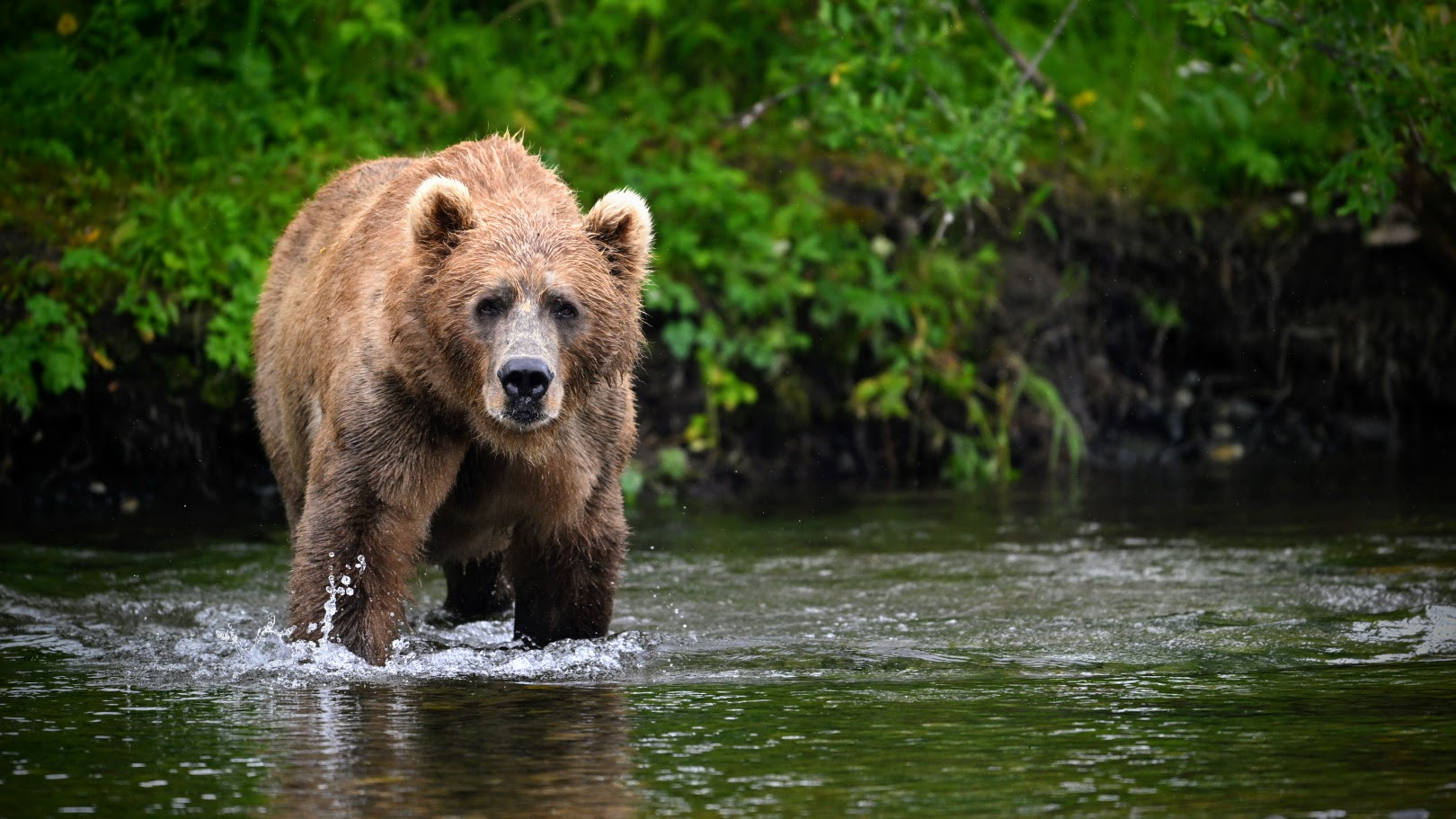
do kodiak bears hibernate picture of bear walking by river bank
Dan M Lee

How is this different from other bears?

Well, while black bears are committed hibernators, and grizzly bears (the Kodiak’s smaller mainland cousins) also den up for the winter, our Kodiak bears play by their own rules.

Polar bears, on the other hand, have a different strategy altogether. Only pregnant polar bears will den. The rest are out and about, toughing out the harsh Arctic winter.

From Encounter to Familiarity

The unique winter habits of the Kodiak bear make them a truly special part of the Alaskan wilderness. It’s a reminder that nature is always full of surprises.

bear viewing and fly fishing in Alaska

Ready for an adventure?

Discover how the Kodiak Bear Center and its partners work to conserve the iconic Kodiak bear through research, habitat protection, education, and sustainable tourism.

Guardians of the Island: How We Work to Conserve the Kodiak Bear

How We Work to Conserve the Kodiak Bear

The Kodiak bear is a global icon of wildness and power, a symbol of the untamed spirit of Alaska. For us at the Kodiak Bear Center, our name carries with it a profound responsibility: to not only celebrate this magnificent animal but to serve as dedicated guardians of its future. The long-term health of the Kodiak bear population is the result of a deliberate, science-based, and cooperative conservation effort.

We want to share how we, along with our vital partners, work to ensure these titans of the Emerald Isle continue to thrive.

A Partnership for Protection

First and foremost, it’s crucial to understand that no single entity conserves the Kodiak bear alone. Our work is part of a collaborative stewardship effort. We work closely with the Kodiak National Wildlife Refuge, which protects two-thirds of the archipelago, and the Alaska Department of Fish and Game (ADF&G), the state agency responsible for managing the bear population. This partnership is the bedrock of Kodiak bear conservation, ensuring that decisions are guided by shared data, rigorous science, and a mutual commitment to the bear’s well-being.

Sow Female Bear With Young
Dan M Lee

Research and Monitoring: The Foundation of Conservation

Effective conservation begins with deep understanding. A key part of our mission is supporting the ongoing research that allows managers to make informed decisions. Biologists from ADF&G conduct regular aerial surveys to estimate population density and track trends across the archipelago. They also perform health assessments and biological studies that provide invaluable data on everything from diet and genetics to survival rates of cubs and adults.

This research helps us answer critical questions: How is the bear population responding to changes in salmon runs? What are the long-term effects of climate shifts on their habitat and food sources? By understanding the challenges bears face, we can better advocate for policies and practices that protect them.

Habitat Protection: Preserving the Home of the Bear

A bear is only as healthy as its habitat. The Kodiak Archipelago is a pristine wilderness, and keeping it that way is paramount.

Our focus is on promoting minimal-impact human activity and advocating for the protection of critical resources. This means safeguarding the salmon-spawning rivers that are the lifeblood of the ecosystem. It involves championing the vast tracts of Sitka spruce forests and the berry-rich hillsides where bears forage. By ensuring the core of their habitat remains wild and undeveloped, we give bears the space and resources they need to flourish without significant human conflict.

fallon parker kbbc guide bears
Fallon Parker

Education and Sustainable Tourism

This is where you, our visitors, become part of the conservation story. We believe that a well-informed public is one of the most powerful forces for conservation. Through our guided experiences and educational outreach, we teach the principles of “Bear Aware” safety and ethical wildlife viewing. We aim to transform visitors from passive observers into active stewards of the environment.

Our operational philosophy is built around sustainable tourism. We ensure our viewing activities do not disturb the bears’ natural behaviors. By demonstrating that a healthy bear population can be a cornerstone of a thriving local economy, we create a powerful incentive for continued conservation.

When you visit us, you are not only witnessing these animals in their natural habitat; you are contributing to the very framework that protects them.

A Shared Future

The conservation of the Kodiak bear is a story of foresight and commitment. It’s a testament to what can be achieved when government agencies, local communities, and dedicated organizations work together. As guardians of this incredible resource, our promise is to continue this legacy of stewardship, to base our actions on sound science, and to inspire a global community to care about the future of the Kodiak brown bear.

bear viewing and fly fishing in Alaska

Ready for an adventure?

fallon parker kbbc guide life of a remote guide

Life of a Guide at KBBC

a season with our guide at kbbc

Here at the Kodiak Brown Bear Center, we provide a unique window into the world of the Kodiak Brown Bear on the remote shores, inlets around Karluk Lake. Our philosophy is rooted in respect, ensuring that every encounter is a safe and minimally invasive experience for both our guests and the bears themselves.

Central to this mission are our dedicated guides. Their deep understanding of bear behavior and commitment to conservation allows for moments of profound connection. To truly convey the power of these experiences, we believe it’s best to hear directly from them.

The following piece is a personal reflection from one of our seasoned guides Fallon Parker. It chronicles her journey from her first youthful, heart-pounding bear encounter to the deep, mutual trust she has since cultivated with the bears of Karluk Lake. Her story is a testament to the remarkable relationships that can form when these powerful animals are met with patience and understanding, and it perfectly captures the spirit of what we do. We are proud to share her perspective.

Bears First

Being born and raised in Montana, I had experience being around bears, but nothing that prepared me for my first encounter with the infamous Kodiak Brown bear. I was 18 years old, had just finished high school and began working as a guide on a Blacktail deer hunt for a client. I was instructed to be out front of the group and warned to keep my eye out for bear. Proceeding on high alert, I kept my eye out for bear and the deer we were pursuing. As I ventured through the brambles (Alders), I became aware of a very distinct smell. A musky, potent stink, Bear. I stopped dead in my tracks.

With my head on a swivel, I searched for any sign of movement or sound, knowing full well these Bruins are capable of moving through brush undetected. I finally caught sight of the biggest bear I had ever laid eyes on and it was staring right back at me. My heart sank, but I realized we were both out there for the same reason.

We were in his world so I backed off and allowed him to proceed along his path. He granted us the same courtesy, never to be seen again.

Four adults stand in a grassy field near a lake, smiling at the camera. Green hills are in the background, and one person holds binoculars. The atmosphere appears relaxed and outdoorsy.
Fallon Parker

A Lesson in Trust

Pursuing the life of an outdoorsman, I have had many more Kodiak Brown bear encounters. My favorite will always be when I started as a guide at the Kodiak Brown Bear Center (KBBC) on Karluck Lake.

It was the summer of 2021, my first time guiding for KBBC. I remember walking out on the trail, asking myself “what am I doing? Purposely walking up to a bear?” This was a whole new world for me as we approached my first bear on the river. I was fighting my natural response of shouting and getting the bear to move away. I looked upon this beautiful mama bear and her second year cubs and realized she had no stress or concern for us. This magnificent animal trusted us and knew we weren’t there to harm her, only to capture her beauty and motherhood.

From Encounter to Familiarity

Since that first exhilarating encounter with the Kodiak Brown bear, I have realized as I start my fourth season at the center, that I have fallen in love with both the encounters and the bears themselves. I have become familiar with each bear‘s personality and face. I can recognize each bear on site. I’m so thankful that these bear encounters have offered me the opportunity to learn about these beautiful creatures through observation. For example, each animal has their own style of fishing. A younger bear may exert themselves running after the fish, but the more mature bears wait patiently for the fish to come to them.

The ultimate expression of trust came when a mother bear, deeming us no threat, walked off to fish and left her young cubs of the year in our care. We became unwitting babysitters, watching in awe as her cubs tumbled and played in the grass nearby, completely at ease with our presence. It was a profound and unforgettable moment of acceptance.

fallon parker kbbc guide bears
Fallon Parker

An Invitation to Witness Wonder

I have come to realize how fortunate an opportunity I have been given here at KBBC, to experience these once in a lifetime encounters with these magnificent animals. The Kodiak Brown Bear Center has offered all of us the chance to experience these infamous creatures in their natural habitat. These animals allow us an opportunity to become a part of their everyday life. Survival. Resilience. Strength. Come see for yourself.

bear viewing and fly fishing in Alaska

Ready for an adventure?