Thirty salmon. Ninety pounds of fish. Six pounds of body weight, gained in a single day.
Those are the numbers a large male Kodiak brown bear can put up at the height of the salmon run, and they are the reason Fat Bear Week exists.
Every autumn the internet votes on which of Alaska’s brown bears has done the best job of getting enormous. What fewer people see is the arithmetic underneath the photos — and it is genuinely staggering.
Here on Karluk Lake, we watch it happen from the water every day of the season. This is what the bulk-up actually costs.
Fat Bear Week 2026: The Dates
Fat Bear Week returns to Katmai National Park from 22 to 29 September 2026, in its thirteenth year. The bracket is revealed on 18 September, voting runs through the week, and the champion is crowned on 29 September. You can cast your vote at fatbearweek.org.
Last year more than 1.7 million votes came in from over a hundred countries — for a single-elimination tournament about fat bears, which tells you something about how much people love them. 32 Chunk goes in as defending champion. 128 Grazer, the first female to win back-to-back titles, is expected on the river again.
Fat Bear Week is a Katmai event, and the bears on the bracket are Katmai bears. But the biology it celebrates is playing out right now across the whole Alaskan coast — including on the Kodiak Archipelago, where the bears grow larger than anywhere else on earth.

The State That Makes It Possible: Hyperphagia
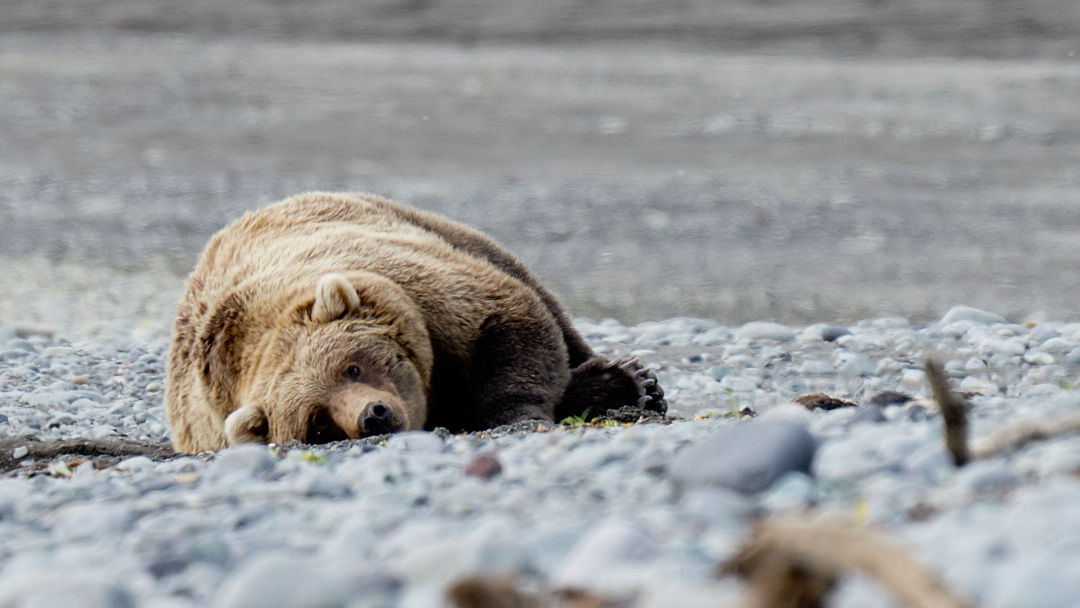
From late summer through to denning, bears enter a physiological state called hyperphagia — literally “over-eating.” It is not greed. It is a hard-wired seasonal switch
The most remarkable part is what happens to the sense of fullness. Leptin, the hormone that signals a body has had enough, is suppressed during hyperphagia. A bear in this state cannot really feel full. It simply keeps eating until it stops to sleep, then wakes and eats again, foraging for as much as fourteen hours a day.
Alaska’s bears have roughly six months to eat a year’s worth of food. Everything else follows from that deadline.
The Daily Numbers
Figures vary by bear, by sex, by rank in the hierarchy and by how good the run is that year. But the well-documented ranges look like this:
Metric | Kodiak Archipelago | Katmai / Brooks River |
|---|---|---|
Salmon per day (large adult male) | Around 30 | Up to 40 |
Weight of food per day | 80–90 lbs | Up to 100 lbs |
Calories per day | 100,000+ | Up to 100,000 |
Weight gained per day | Up to 6 lbs | Up to 4 lbs |
Adult male weight (in season) | 700–1,000 lbs | 700–900 lbs (midsummer) |
Very large males | Up to 1,400–1,500 lbs | Over 1,000 lbs (by October) |
To put a single fish in context: a sockeye salmon caught before it spawns carries roughly 4,500 calories. A former Katmai ranger once watched the big male 856 catch and eat around eighteen sockeye across five hours — more than 80,000 calories in one evening’s fishing.
An adult human eats somewhere near 2,000 calories a day. A Kodiak bear in hyperphagia can clear fifty times that.
The Whole Season Numbers
Daily figures are dramatic, but the annual numbers are the ones that stay with you.
Researchers studying Kodiak bears used stable isotopes and mercury deposited in the animals’ hair to work out how much salmon each bear actually consumed over a year. Adult males averaged around 2,788 kg of salmon annually — roughly 6,100 pounds of fish per bear, per year. Adult females averaged about 1,364 kg, near 3,000 pounds.
The same study found something that matters well beyond bear trivia: intake rose by about 62% as salmon escapement increased. More fish left in the river means measurably bigger bears. Salmon managed purely for maximum fishery yield may sit well below what the ecosystem needs to be at its most productive. The bears are, in a real sense, a readout of how healthy the runs are.
Southwestern Kodiak’s three great lake-river systems — Karluk, Frazer and Ayakulik — carry all five Pacific salmon species and the archipelago’s highest salmon abundance. That is not incidental to why the bears here are the size they are. It is the whole explanation.
Why They Leave Good Fish on the Bank
Visitors are often taken aback by this. When salmon are abundant, bears stop eating whole fish and start being selective, a behaviour called high-grading.
They take the brain, the skin and the eggs, and leave the fillet behind.
It looks wasteful and it is exactly the opposite. Those are the fattiest, most calorie-dense parts of the animal. When the constraint is not finding food but processing it, the efficient strategy is to skim the richest tissue from many fish rather than fully consume a few. A bear with limited stomach capacity and a hard denning deadline is optimising for calories per minute of feeding, not for tidiness.
The leftovers do not go to waste either. Gulls, foxes, eagles and the streams themselves take up what the bears leave, moving marine nutrients into the forest. It is one of the quiet reasons salmon are the lifeblood of Kodiak Island.
What All That Fat Is Actually For
Here is the part Fat Bear Week gets right in spirit and most people underestimate in scale.
A bear emerging from the den in spring has lost up to a third of its body weight. Lactating females — who gave birth mid-winter and nursed cubs the whole time without eating — lose more.
Through denning, a bear does not eat, drink, urinate or defecate, in some cases for as long as eight months. And yet it comes out having lost very little bone mass or muscle tone, with no sign of the kidney failure that immobility of that duration would cause in a human. NASA researchers and medical scientists have studied Kodiak denning physiology for precisely this reason.
So a fat bear in September is not an indulgent bear. It is a bear that will survive to April. The ones who fall short may not. Not every Kodiak bear even dens — the archipelago’s mild winters and late runs mean some large males stay active straight through, and what happens inside the den itself is stranger still.
Kodiak's Place in the Fat Bear Story
Kodiak bears are their own subspecies, Ursus arctos middendorffi, isolated on this archipelago for roughly 12,000 years. Around 3,500 of them live here. A large male can stand over ten feet tall on his hind legs and weigh up to 1,500 pounds — the largest bears in the world, and a genuinely different animal from an interior grizzly despite sharing a species.
Fat Bear Week is something you watch on a screen. The bulk-up itself is something you can stand in front of. During the late-season salmon runs, Karluk Lake holds one of the highest concentrations of brown bears anywhere — bears fishing, high-grading, sleeping it off and doing it again, from mid-August through to the dens.
Watching a 1,000-pound animal eat its thirtieth fish of the day, from a boat on a lake in the middle of a wildlife refuge, or on land; reorganizes your sense of scale permanently.
Where the Bears Roam Free
Private cabins • All-inclusive meals • Float plane access • Sauna
Check AvailabilityFrequently Asked Questions
How much does a bear eat in a day before hibernation?
A large adult male coastal brown bear may eat 80 to 90 pounds of food a day during hyperphagia, which works out to roughly 30 salmon and well over 100,000 calories. Smaller and lower-ranking bears take considerably less.
How much weight can a bear gain in one day?
Up to about six pounds a day for adult male coastal brown bears at peak feeding. The National Park Service cites around four pounds a day for Katmai’s bears.
How many calories are in a salmon?
A sockeye salmon caught before spawning contains roughly 4,500 calories. Its value drops as it spawns and its body condition declines, which is why timing matters so much to a feeding bear.
Why do bears only eat part of the salmon?
It is called high-grading. When fish are plentiful, bears eat the brain, skin and eggs — the fattiest parts — and leave the rest, maximising calories gained per minute spent feeding.
How much weight do bears lose over winter?
Up to a third of their body weight. Females who give birth and nurse cubs in the den lose more.
When is Fat Bear Week 2026?
22 to 29 September 2026, hosted by Katmai National Park. The bracket is revealed 18 September and the champion is crowned 29 September.

Content Author & Alaska Photographer
I lead photography workshops at the Kodiak Brown Bear Center and create engaging, high-quality content for blogs and websites across Alaska and beyond. My deep passion for wildlife—especially Kodiak bears—continually inspires my work and fuels my storytelling.
Sources
Alaska Department of Fish and Game — Kodiak Brown Bear Fact Sheet
U.S. Fish & Wildlife Service — Fat Bear Diet Plan
National Park Service, Katmai — Fat Bear Week 2026
National Park Service, Katmai — Bigger is Better? (M. Fitz)
U.S. Department of the Interior — Katmai’s Fat Bears
Van Daele et al., Salmon consumption by Kodiak brown bears with ecosystem management implications, Canadian Journal of Zoology
Explore.org — Fat Bear Week